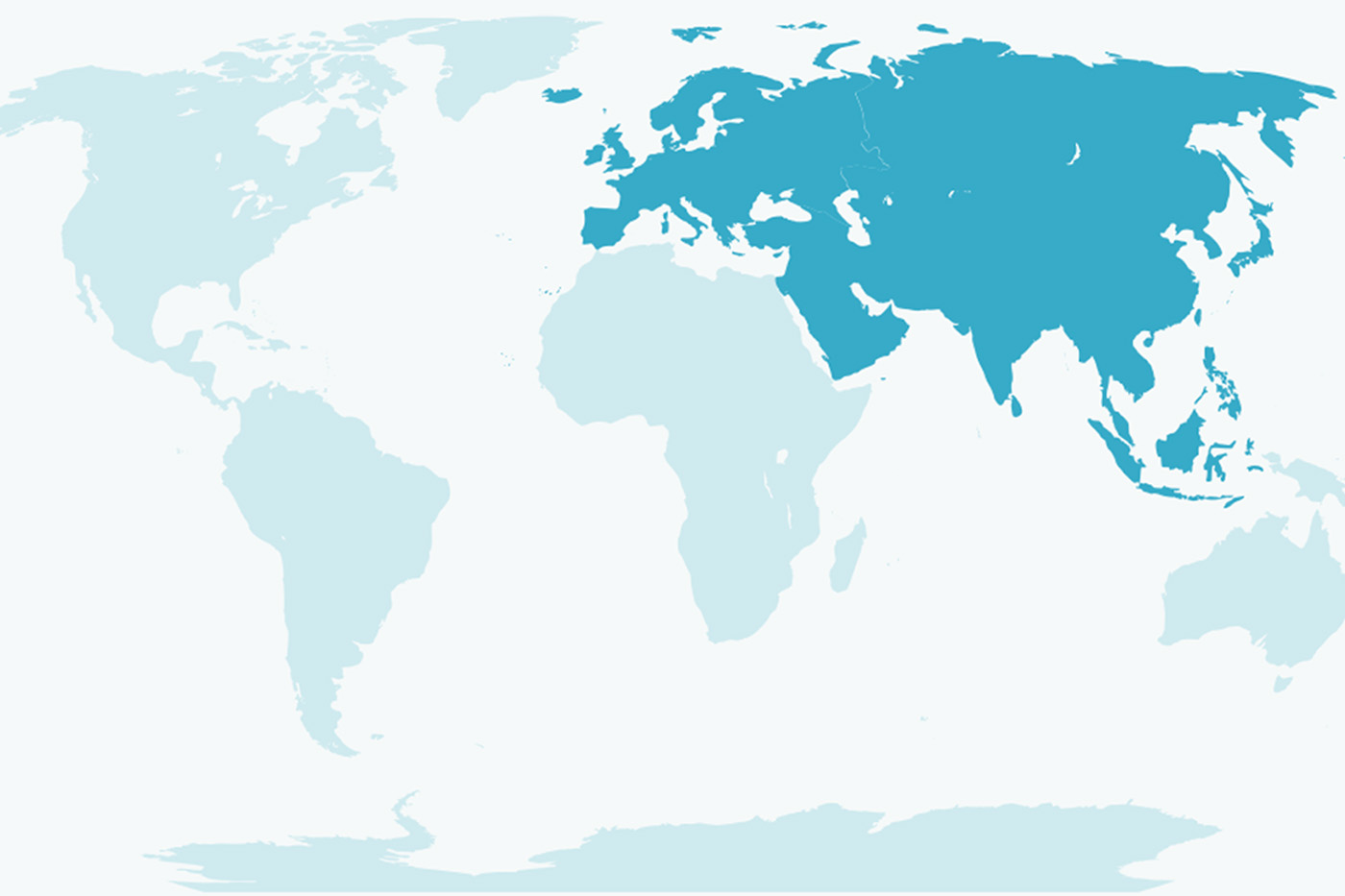

Since around 2015, a new system has been taking shape in Northern Europe that aims to harmonize and unify, to a certain extent, trademark registration in Armenia, Belarus, Kazakhstan, Kyrgyzstan, and Russia. It is known asthe “Eurasian IP System,”or, in Spanish, the Eurasian Intellectual Property System.
The Eurasian System was established primarily within the framework of the“Eurasian Economic Union (EAEU)” and is based on the“Treaty on the Eurasian Economic Union.” For now, only the five countries mentioned are members, but it is quite possible that other countries in the region will join over time.

For us Spaniards—and, in general, for the Western world—the Eastern markets on our continent may seem somewhat unfamiliar, distant, of little relevance, or very removed from our daily lives, which are so focused on the European Union and the Americas. However, globally—especially in Asia—these markets are of immense importance. The Russian market looks primarily toward Asia, and this process of integration with other countries in the region to boost their economies has been underway for many years.
The alliance among these five countries aims to establish a single free economic zone in which goods, capital, services, and people can circulate freely within a single market and under a framework of coordinated customs integration.
As far as our profession is concerned, the new trademark registration system is about to be implemented—it was originally scheduled for 2020—as yet another opportunity for trademark registration and protection, even though there are still many details to be worked out. In addition to the logical objectives of any common market, it appears that this new system also aims to streamline trademark registration in these jurisdictions.
When compared to other well-known registration systems, it would generally be more similar to the Madrid System than to the European Union trademark system or the one administered by the African Intellectual Property Organization (OAPI). It is not a completely unified system, but rather one that allows for the obtaining of a trademark registration covering a bundle of national registrations while maintaining a certain degree of unity and centralization for certain procedures and aspects. Therefore, once this new registration system enters into force, it will constitute yet another strategic option for the protection and internationalization of trademarks.
Some details about what will become the Eurasian Trademark System are already known. Here are a few highlights:
- The application shall be a single application and shall be filed with any intellectual property office of the applicant's choice among those in Armenia, Belarus, Kazakhstan, Kyrgyzstan, and Russia.
- One of the offices of the member states will serve as the “receiving office” and will be responsible for conducting a formal review of the application.
- The substantive examination will be conducted by the intellectual property office in each country.
- As one might expect, the official language will be Russian.
- For a trademark to be granted, it must be granted in all countries. In other words, even though a trademark, once granted, consists of a bundle of national registrations, it must be granted by all offices. Otherwise, it will be necessary to convert the Eurasian registration into separate national registrations.
- The procedure is expected to take approximately one year.
- There will be an opposition procedure with a 3-month deadline. The opposition must be filed with the receiving office where the application was submitted.
- It is expected that use of the trademark in one of the countries will serve as proof of use in the others.
- It is unclear which office one must file a trademark renewal application with, but it stands to reason that it must also be filed with the office that received the original trademark application.
- It is unknown whether the Eurasian Trademark is expected to become part of the Madrid Protocol. Therefore, it will not be possible to designate this jurisdiction through the Madrid system, at least in the short to medium term.
- At present, there are no courts or a unified, centralized Eurasian administrative body. Therefore, it appears that administrative matters must be addressed with the office through which the trademark application was filed, and legal matters will be heard by the competent national court.
It will be very interesting to see how this new Eurasian System and the Madrid Protocol coexist in practice. The reality is that the Madrid Protocol allows for the protection of trademarks not only in Armenia, Belarus, Kazakhstan, Kyrgyzstan, and Russia, but also throughout virtually all of Northern Europe and much of Asia through a procedure that is partially centralized in the initial stages and currently allows for a more or less centralized management of trademark portfolios.
Author: Cristina Arroyo
Previously published in Economist & Jurist