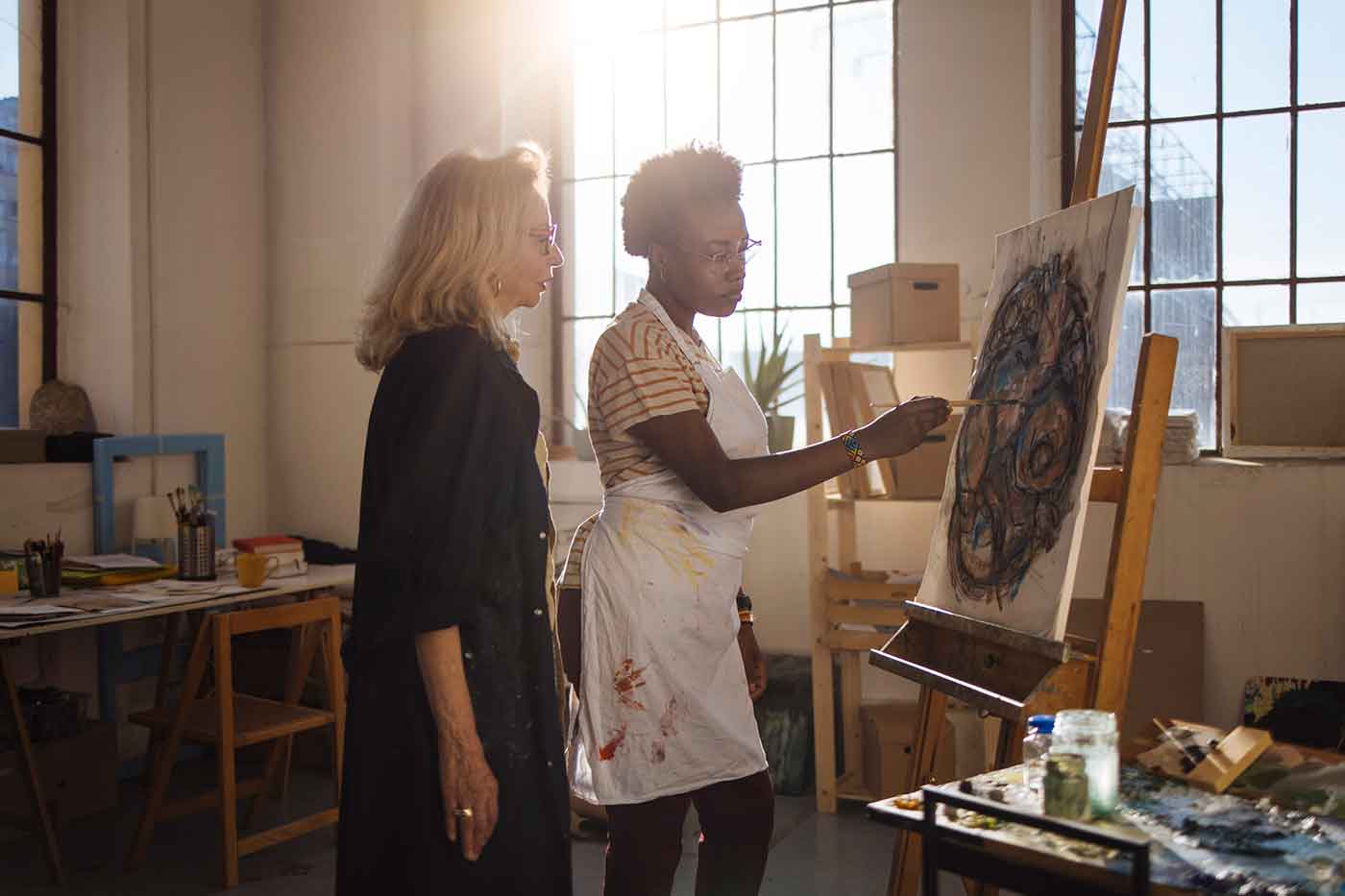

Today we spoke with Carlos Morán, a partner at Elzaburu who specializes in industrial and intellectual property litigation and unfair competition, about a recent Supreme Court ruling that has generated interest in the field of copyright and co-authorship in artists’ studios. Below, Carlos answers a series of questions that help clarify the practical scope of this ruling and the implications it may have for artists, collaborators, and professionals in the sector.
Context
The September 30, 2025, ruling by the Civil Chamber of the Supreme Court addresses, for virtually the first time, the issue of determining the authorship of works of art created in the context of an artist’s studio, but the reality is that the appeal had very little room for maneuver, and the Supreme Court essentially upheld the appellate ruling issued by Section 28 of the Provincial Court of Madrid on March 21, 2021. The case before the Supreme Court was already weighed down by the evidence presented at the trial court level and by the forcefulness of the appellate ruling. The Supreme Court adds little to it. The cassation ruling accepts as valid the facts found to be proven in light of the evidence presented and the legal rulings of the Provincial Court. The limitations inherent in the cassation appeal did the rest.
Supreme Court Criteria for Distinguishing Between Technical Assistance and Creative Contribution
Rather than legal principles, the Supreme Court has taken into account the facts that emerge from the evidence presented, namely:
- The plaintiff was an artist with proven professional qualifications.
- The salary he received for his work with the defendant was quite high.
- The plaintiff worked alone in the studio for many hours a day, and the defendant often traveled quite a bit
- Under these circumstances, it seems reasonable to assume that the plaintiff, when translating the defendant’s ideas into the painting, enjoyed creative freedom to express her own personality as well.
The Supreme Court’s ruling notes on several occasions that, according to the Provincial Court—whose assessment of the facts and evidence must be respected—the tasks performed by the plaintiff were “extremely important” and not merely “ancillary” or “complementary” to those of the defendant.
Employment Relationship and Recognition of Co-authorship: Potential Conflicts
The existence of an employment relationship between the parties, as established in a prior labor court ruling, was not taken into account by the Supreme Court due to a procedural issue: labor court rulings are not binding on civil courts. In a sense, the facts and evidence directly presented in the civil lawsuit take precedence over the precedents derived from the labor court ruling.
That said, it stands to reason that the existence of an employment relationship does not prejudge—for better or for worse—the facts of the case, which must be proven on a case-by-case basis. It is another matter entirely that the employment contract, as we will discuss later, may specify or emphasize certain conditions or characteristics that refute the notion that the tasks performed by the assistant or collaborator involve creativity.
The Significance of Working Alone in Determining Co-authorship
The fact that the co-author created the work on her own is yet another circumstance that demonstrates to the court— when considered in conjunction with all the other factors—that she imbued the works with her own personality or was in a position to do so. The ability to make choices is best exercised in solitude.
Obligations of the Lead Artist Following Recognition of Co-authorship
This is essentially a declaratory judgment (recognizing the plaintiff’s status as a co-author of the 221 works) that includes a single order of relief: the defendant must publish, at his own expense, an announcement in a nationally circulated art magazine stating that the plaintiff has been recognized as a co-author of the 221 works listed in the judgment.
Impact of the ruling on contemporary artists' studios: when working with collaborators or assistants
Artists’ studios have been a constant feature in the history of art and are not called into question by this legal precedent. The Supreme Court’s ruling, in fact, expressly addresses any misinterpretation of its decisions and any attempt to extrapolate or generalize its doctrine to the current situation of any artist’s studio. On this point, the ruling expressly states: it is not a matter of saying that any technical assistant in a studio can be considered the author of an artistic work in which they participated, but rather that “in this particular case,” the plaintiff, in the solitude of the studio, was capable of giving form to the defendant’s ideas by making her own decisions based on her personality.
That doesn't mean we can't learn from this situation:
- First, an artist who works in a studio setting with collaborators and assistants should take care to specify in the contract signed with them the circumstances that make it clear that the creative aspect—both in the conception and execution of the painting—belongs to the artist, that the collaborators’ contribution is purely technical, and that they have no freedom of choice or discretion in the creation of the work.
- Second, the artist must apply these contractual principles to the practice of his or her work in the studio, truly taking on the responsibilities that fall to him or her, beyond what is simply set forth on paper.
- Third, should the matter go to trial, one must not dismiss the evidence presented at the trial court level, nor fall into contradictions, nor adopt a high-handed attitude during cross-examination. It appears that the witness testimony and the cross-examination of the defendant may have played a decisive role in the case.
The Impact of Co-authorship on the Principal Artist's Intellectual Authorship
From a practical standpoint, it does not appear that the ruling will have any effects on the artist beyond the reputational aspect. All indications are that the paintings were commissioned and had already been sold, so their commercial exploitation has been virtually exhausted.
Otherwise, the artist has not lost his status as the author; it is simply that he must share that status with the plaintiff. In practice, this means only that if the artist wishes to refer to those 221 paintings, he would have to state (make it clear) that the plaintiff is a co-author.
Decisive evidence in establishing creative contribution
It appears, as we have already noted, that the witness testimony and the defendant’s cross-examination may have been decisive for the Provincial Court in determining how the plaintiff worked at the defendant’s workshop. These cross-examinations seem to have taken precedence over the expert opinion submitted by the defendant, the content of which is not sufficiently addressed in the judgment.
Could this ruling set a legal precedent relevant to the recognition of co-authorship in other similar artistic cases?
The ruling does not constitute“case law”in the strict sense, as it is practically the first of its kind. It is a ruling that relies largely on the CJEU’s doctrine regarding authorship/originality and cites a foreign precedent (the French ruling in the Renoir case). The Supreme Court itself also rules out a broad interpretation extending to other cases and emphasizes that its decision is based on the specific circumstances of this case.
However, the fact that the Supreme Court ruled in favor of the collaborator rather than the artist could lead to the mistaken belief that the floodgates have opened and that any“assistant”can follow the plaintiff’s example. It is necessary to guard against this kind of interpretation.
Legal Recommendations for Artists Who Work with Assistants
Given that the ruling should not cause anyone alarm, it is advisable for artists who work in a studio setting with collaborators to take this opportunity to review their contractual and factual situations to determine whether or not there is any risk to them arising from the ruling’s findings.