
In a well-known passage from our most universal work, *Don Quixote of La Mancha*, his friend Sancho said to himself: “I have seen a thousand signs that my master is a madman through and through, and I, too, am not far behind him, for I am more of a fool than he is, since I follow and serve him—if the saying is true that goes, ‘Tell me who you walk with, and I’ll tell you who you are,’ and the other one: ‘It’s not who you’re born with, but who you hang out with.’”
All you need to know is who someone hangs out with or sleeps with to figure out their personality, their way of thinking, and—why not?—even their political leanings.
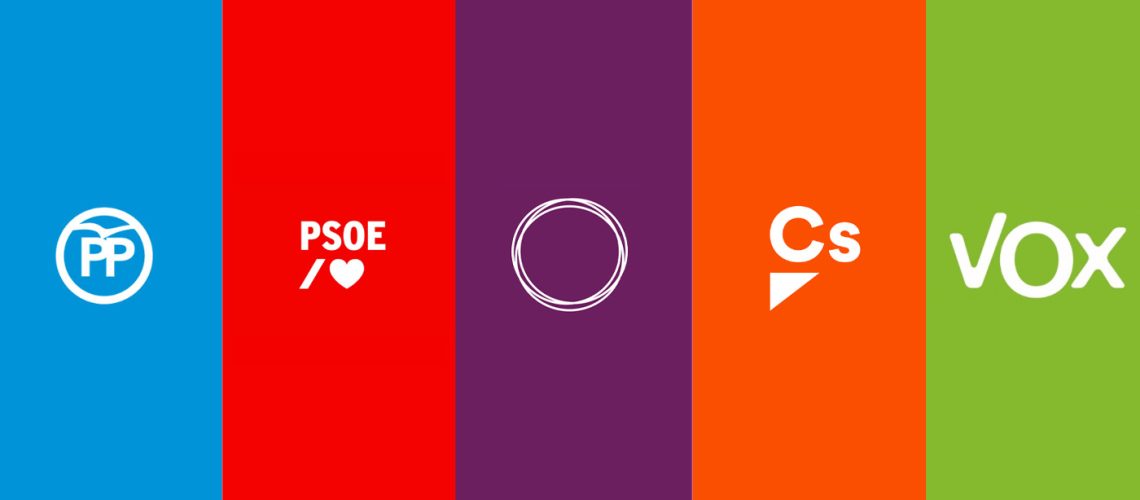
It’s election season once again. Politicians have taken the stage, along with wordplay, demagogic promises, and… an increasingly polished presentation in which color also seems to play a significant role. The blue of the PP, the red of the PSOE, the orange of CUIDADANOS, and the purple of PODEMOS are now joined by the green of VOX.
Traditionally, blue—a cool, conservative color associated on the political spectrum with the right and conservatives—has been linked, according to experts at
on the psychology of colors, with professionalism, stability, credibility, trust, and even loyalty, security, and steadfastness. Red—a warm, emotional color generally used in politics by left-wing and liberal forces—has always been considered representative of vitality, aggressiveness, passion and enthusiasm, energy, and action. Orange—a warm, sociable, and friendly color that in politics has been linked to various political ideals, though most commonly to Christian Democratic parties—is associated with joy and youth, temperance and sobriety, while also representing optimism, enthusiasm, creativity, modernity, and inspiration. Purple—a cool, deep color linked in the political sphere to feminist movements—has been associated with mystery, magic, melancholy, and dignity; with extravagance and criticism; as well as with wisdom and power (it was, after all, the color of the clergy and the nobility). Over the past decade, these four colors have enlivened our political scene, and we all associate them with one political party or another. But in recent months, the color green—the color of nature and, therefore, of environmental movements—has emerged with great force, and never has this been more apt. The psychological properties of green—a cool color—may seem somewhat paradoxical given what it represents in our current political landscape; it is a refreshing, soothing, and calming color (in fact, it is the color of hospitals and surgeons’ scrubs), primarily associated with stability, balance, tolerance, and sensitivity, symbolizing security and hope.
The psychological aspects of color are very much a part of our daily lives, even if we aren't aware of it. They play an important role in the worlds of marketing, advertising, and design.
In the professional field in which I work—that of trademark protection and defense—color has recently taken on a very important, even pivotal, role. Companies seek to differentiate themselves not only through the products they sell or the services they provide, but also through their association with a particular color, which they attempt to protect—not always with equal success—as a trademark. In the telecommunications industry, blue is the color of TELEFÓNICA, orange is ORANGE’s, red is VODAFONE’s, and purple is ONO’s and YOIGO’s; in the banking sector, we all associate blue with BBVA and SABADELL, red with SANTANDER, green with BANKIA, and orange with BANKINTER or ING; in the insurance sector, red stands for MAPFRE or LÍNEADIRECTA, blue likely for PELAYO or MUTUA MADRILEÑA, and orange for VERTI; in the chocolate industry, red stands for NESTLÉ and purple for MILKA.
However, this psychological association between colors and trademarks is not always complete, since it is usually linked to the name or other graphic elements, without which consumers would not be able to recognize or deduce the origin of the products or services.
A single color is not distinctive for any goods or services, except in exceptional circumstances; those cases in which the applicant can demonstrate that the mark consisting of a color is unusual, that it is striking in relation to the specific goods or services, or that it has acquired distinctiveness as a result of the use made of it—that is, that it is capable of distinguishing certain goods and services from those of other companies. These are very specific cases, such as the European Union trademark consisting of the color lilac or purple for chocolate registered by Kraft Foods; Deutsche Telekom’s registration of the color magenta for telecommunications services; 3M’s registration of the color yellow for sticky notes; Hilti’s registration of the color red for hammer drills; and Chep’s registration of the color blue for pallets.
Most often, however, these attempts at registration are unsuccessful. The aim is to prevent the creation of unjustified monopolies on color shades, which could ultimately give the owner an unwarranted competitive advantage to the detriment of new businesses. Some examples of trademark rejections within the European Union include Banco Santander’s red and BBVA’s blue in the banking sector, and Orange’s orange and Telefónica’s blue in the telecommunications sector.
In the political arena, the psychological perception of colors and their association with one political party or another does not align with their distinctiveness and registrability. Political parties do not seem particularly inclined to register their colors as trademarks, likely because—aside from the difficulties they might encounter—each political party has its own color, whether or not it is registered.
In politics, color is used as a means of distinguishing one party from another, not to create an association with the psychological characteristics of their symbols or their ideological positions. They have succeeded in making us associate blue, red, orange, purple, and green with a political symbol rather than with a way of being.
Tell me what color you prefer, and I'll tell you what you're like… or who you vote for.
Author: Luis Baz