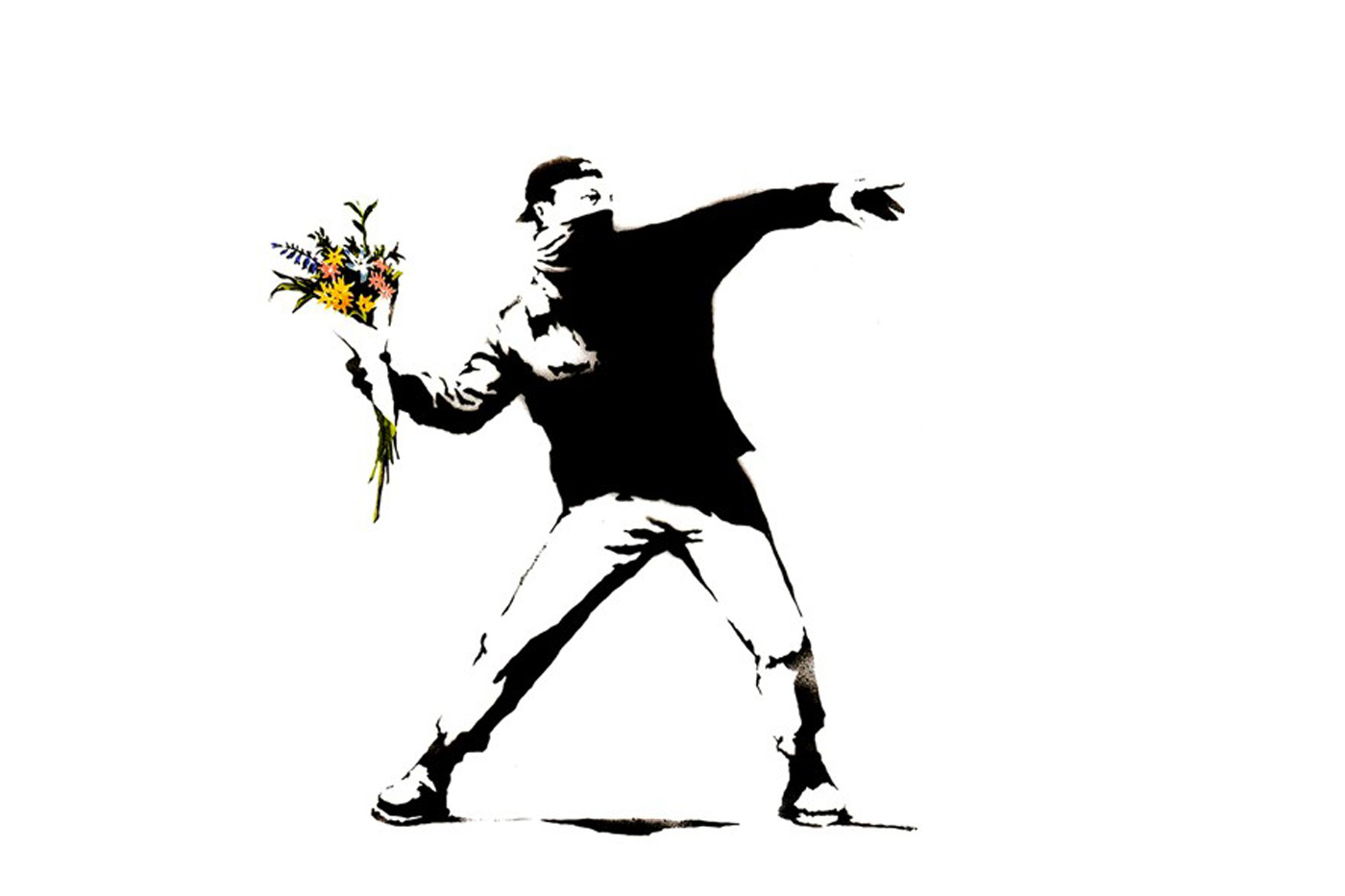

Traditionally, news articles tend to grab readers’ attention with sensational headlines that do not always reflect the reality of the story they cover. In recent days, many media outlets have reported on the alleged“loss of the legal battle”by the famous street artist Banksy to“retain his copyright”over the iconic graffiti piece“The Flower Thrower.”
It is said that a“court” issued a“ruling”in which the“judges”“denied”this artist’s copyright in“a lawsuit”against a company that sells postcards—all because Banksy chose to remain anonymous. Perhaps it is worth trying to put things in their proper context.

The“ruling” is actually a decision dated September 14, 2020, issued by the Cancellation Division of the EUIPO—that is, the European Union’s trademark and design registration authority; the“lawsuit”is in fact an“administrative”action for trademark invalidation filed against a figurative trademark registration that reproduces the image of Banksy’s work for various goods listed in the International Classification.
The trademark is owned by Pest Control Office Limited, whose connection to Banksy is accepted by the EUIPO without going into too much detail; and the party seeking the declaration of invalidity is Full Colour Black Limited, which is seeking to have the registration canceled so it can sell postcards featuring the image of the famous graffiti.
The action for invalidation is based on the prohibition, contained in the European Union Trademark Regulation, against the registration of signs applied for “in bad faith.” In the case of the trademark that is the subject of the action, bad faith is justified by the fact that the trademark owner, Pest Control Office Limited, never intended to use the trademark in the marketplace to market products, but rather applied for it to prevent others from doing so. This intent is contrary to the essential function of a trademark.
It is true that, in reaching this conclusion, the EUIPO’s decision analyzes artist Banksy’s choice to remain anonymous and the explicit authorizations granted by the trademark owner to reproduce the work“The Flower Thrower”provided it is not for commercial purposes. However, the copyright considerations contained in this decision are merely“obiter dictum” statements by an administrative authority that invalidated a trademark registration because the owner had no intention of using it at the time of application.
More importantly, the fact that Pest Control Office Limited has lost the right to exclusively use Banksy’s work as a trademark for certain products—as a result of the cancellation of the registration—does not mean that Banksy has lost his copyright in this work or the right to take legal action for infringement against anyone who attempts to make commercial use of it.
In light of this“administrative” precedent set by the EUIPO, it is worth recalling that our country has a“judicial” precedent that is much more in line with the orthodox continental conception of copyright, in a case involving another internationally renowned street artist.

I am referring to the ruling by the Madrid Provincial Court on November 2, 2018, which recognized Keith Haring’s intellectual property rights over his iconic work “Rampant Heart” and found a company liable for infringement for having launched a large number of merchandise items featuring a logo very similar to Haring’s, with the addition of the word “Madrid.”
The fact is that art, when it has the power to move people, does not depend on where it is exhibited—whether on a wall in Jerusalem, in a gallery, or online; nor does it even depend on the artist’s attitude, whether they embrace anonymity or flaunt their authorship. Art does not deserve to be exploited for lucrative marketing purposes beyond the control of its creator. And in Europe today, it’s reasonable to assume that such practices are not immune to this trend.
Author: Antonio Castán
Previously published in Expansión