
The recent decision by the European Union Intellectual Property Office (EUIPO) to declare the European Union collective trademark “JABUGO”—owned by the Asociación Auténtico Jabugo—null and void, at the request of the Regulatory Council of the Protected Designation of Origin (PDO) “Jabugo,” has reignited the debate over the boundaries between trademark law and geographical indications.
The ruling provides a significant opportunity to analyze how the distinctiveness requirements are applied in the context of collective trademarks, particularly when such trademarks incorporate geographic names that are widely recognized by the public.
Why the EUIPO Considers That “Jabugo” Cannot Be a Valid Collective Mark
Article 7(1)(c) of the European Union Trademark Regulation (EUTMR) prohibits the registration of trademarks consisting exclusively of signs or indications that may serve, in trade, to designate, among other things, the geographical origin of the goods or services.
However, in the specific context of collective marks, Article 74(2) of the EUTM Regulation establishes an exception: signs that may serve to indicate the geographical origin of goods may constitute collective marks. This provision is known as the geographical exception.
However, this exception does not exempt collective marks from compliance with the other absolute grounds for refusal set forth in Article 7(1) of the EUTM Regulation. Therefore, the exception under Article 74(2) of the EUTM Regulation applies only to those collective marks that are distinctive.
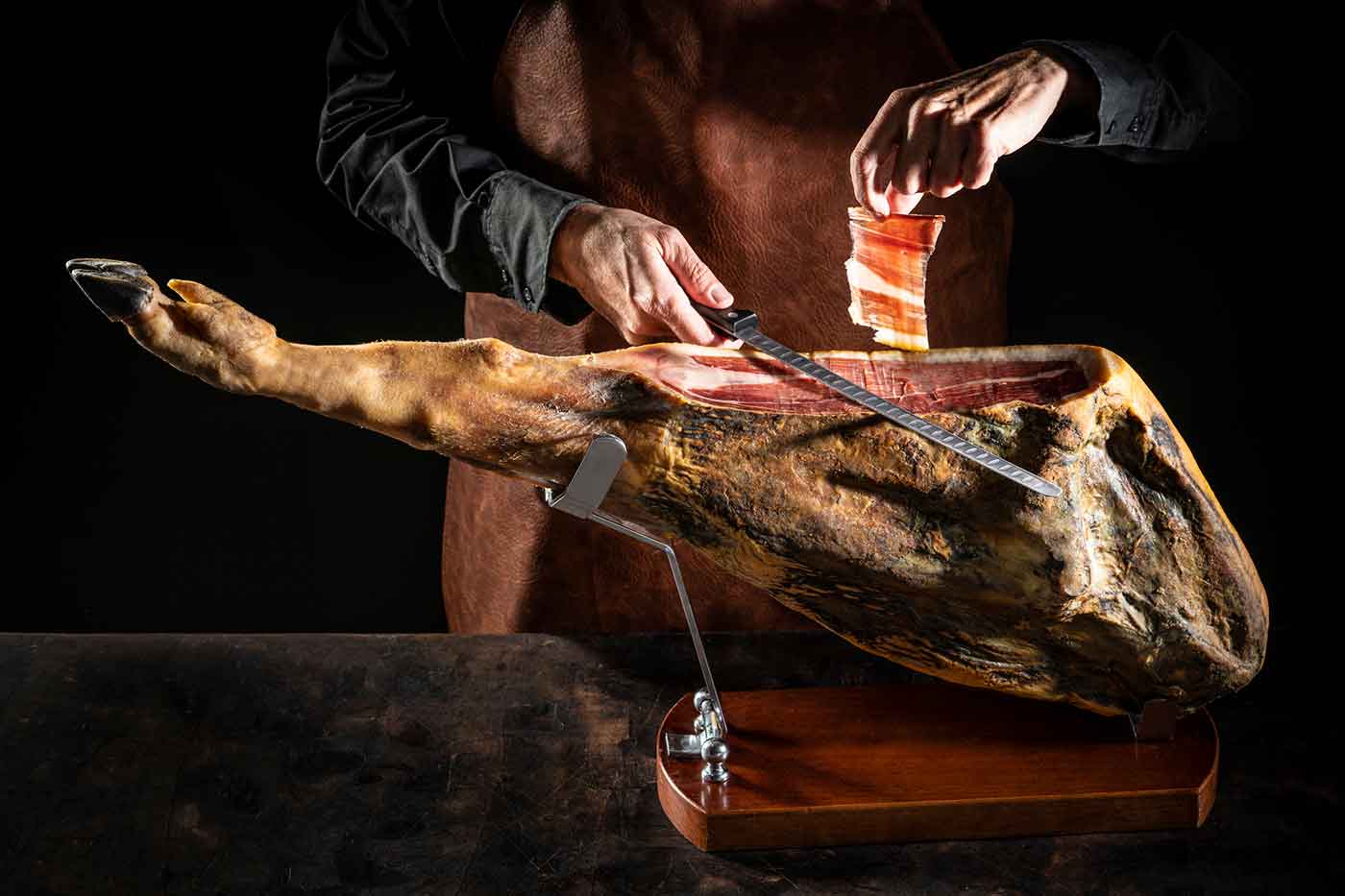
In the decision under review, the Cancellation Division concludes that, as of the filing date of the contested trademark, the term “Jabugo” was recognized as a municipality in the province of Huelva where high-quality hams and related products are produced. Consequently, Spanish consumers will perceive the sign as a direct reference to the geographic origin of the products for which the collective mark was registered, and the mark is declared invalid for lacking sufficient distinctiveness.
What does it mean for “Jabugo” to be considered a descriptive term?
The Cancellation Division concludes that the contested trademark, although descriptive of the geographical origin of the goods, could be covered by the exception set forth in Article 74(2) of the EUTMR. However, that geographical exception does not exempt it from meeting the distinctiveness requirement set forth in Article 7(1)(b) of the EUTMR with respect to all the contested goods.
The direct consequence of this finding is that the Auténtico Jabugo Association cannot claim exclusive rights to the term “JABUGO” under European Union trademark law.
What evidence was required to prove distinctiveness acquired through use?
To establish that the term “Jabugo” had acquired distinctive character through use, the Asociación Auténtico Jabugo should have demonstrated that the relevant public in the European Union perceives the term “Jabugo” as an indicator of the collective commercial origin associated with its members.
This type of accreditation requires solid evidence, including, but not limited to:
- Perception surveys conducted in several Member States.
- Extensive and detailed data on sales, advertising, and commercial presence that demonstrate the use of the term as a trademark.
- Information regarding the brand's market share.
- Evidence regarding the intensity, geographic scope, and duration of the sign's use.
- Evidence of the proportion of the relevant public that identifies the products as coming from a specific company based on the brand.
The ruling notes that the statements provided by the Chambers of Commerce refer to the terms “name,” “reference,” or “product” when mentioning “Jamón de Jabugo,” but do not establish that “Jabugo,” on its own, is perceived as a trademark that identifies the hams produced by the members of the association in question.
Practical Consequences of the Nullification for the Auténtico Jabugo Association and the Industry
The immediate consequence of the declaration of invalidity is that the Auténtico Jabugo Association cannot claim exclusive rights to or monopolize the term “JABUGO” through a collective trademark.
Furthermore, only ham producers who meet the requirements established by the “Jabugo” Protected Designation of Origin may use that term. Consequently, companies that belong to the Auténtico Jabugo Association but do not meet the PDO requirements may not use the term “JABUGO” to refer to their products.
Relationship Between the Canceled Trademark and the “Jabugo” PDO
In practice, the invalidated collective trademark and the PDO will not coexist. With the trademark registration now void, the legitimate use of the term “Jabugo” is exclusively tied to compliance with the requirements of the Protected Designation of Origin.
Thus, if any of the companies belonging to the Auténtico Jabugo Association fails to meet the PDO requirements, it will not be allowed to use the term “JABUGO” to refer to hams.
Future Scenarios: Resources, New Entries, and Control Over the Use of the Term
The decision of the Cancellation Division may be appealed to the Board of Appeal of the EUIPO until January 19, 2026. If the appeal is denied, a further appeal may be filed with the General Court of the European Union.
A new EU trademark application consisting of the term “JABUGO” and covering “hams” would be opposed on the same grounds on which the “JABUGO” registration was canceled (lack of distinctiveness). Article 7(1)(j) of the EU Trademark Regulation might also apply, under which the registration of trademarks that include designations of origin will be refused provided that certain conditions are met.
Once the decision becomes final, the next step for the Regulatory Council will be to ensure that all uses of the term “JABUGO” comply with the PDO, since members of the Auténtico Jabugo Association who do not meet its requirements will not be able to rely on the collective mark to use that term.
Elzaburu has extensive experience in industrial and intellectual property, advising companies and associations on the registration, protection, and defense of trademarks, designations of origin, and other intangible assets, with a rigorous and up-to-date approach to the law.
Marta Rodríguez, Senior Associate in the Trademark Practice Group at Elzaburu.