

Soccer is about much more than just scores or player signings. You only have to look at the big clubs to see this: they are surrounded by stadiums, sponsors, jerseys, content, experiences, fan communities spread all over the world, and, of course, an identity that has economic value in its own right.
The report Brand Finance’s “Football 50 2026” estimates the combined value of the world’s 50 most valuable soccer club brands at 23.9 billion euros. According to the report, this represents the highest annual growth recorded in the ranking’s 15-year history, and the top ten clubs account for more than 60% of the total value.
Real Madrid CF remains at the top, ranking first for the third consecutive year, with a brand value of 2.4 billion euros (25% more than the previous year). FC Barcelona follows, with nearly 2 billion euros and 15% growth.
Now, what does it really mean for Real Madrid's brand to be worth 2.4 billion euros? The following sections address that question, but first it's worth pausing to consider a statistic that explains much of this phenomenon.
An increasingly concentrated market
The ranking shows that value is concentrated in a few clubs—those with truly international reach. Their standing is not determined solely by their athletic performance, but also by their ability to generate commercial revenue, attract sponsors, capitalize on their stadiums, and maintain global fan communities.
The gap between the top clubs and the rest continues to widen. The top ten brands account for more than 60% of the total value of the ranking (nearly 15 million euros), and since 2012, their combined value has grown by 250%, compared with a 220% increase for the Top 50 as a whole.
The Spanish case clearly illustrates this asymmetry. The seven Spanish clubs in the ranking— Real Madrid, FC Barcelona, Atlético de Madrid, Real Betis, Athletic Club, Villarreal CF, and Real Sociedad —account for 14% of the brands included, but nearly 23% of the total value.
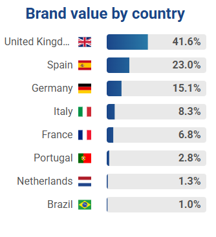
Brand Value of Soccer Clubs by Country
The biggest gainer in the 2026 edition is Arsenal FC, which climbs five spots and enters the top three most valuable brands for the first time. Its brand value increases by 28 percent, to approximately 1.5 billion euros.
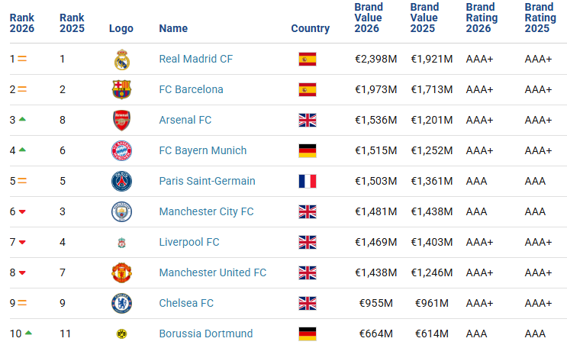
Top 10 Soccer Clubs by Brand Value
What Does Brand Value Mean?
The basic idea is simple: a brand has value when its name, its symbols, and everything the public associates with them are capable of eliciting a response that would not occur in the same way without that identity.
In soccer, this is particularly easy to see. A team crest is more than just a design, and a jersey is more than just a piece of clothing. For a fan, they can represent a sense of belonging, memories, tradition, or rivalry. For a company looking to sponsor a club, however, that same identity means access to an audience, international visibility, and association with certain values. That combination can boost demand for tickets, official merchandise, experiences, sponsorships, and licensing.
The two dimensions coexist and reinforce each other. The fan’s emotional connection underpins much of the brand’s commercial appeal, and, in turn, that commercial potential allows the brand to expand into new markets, products, and experiences.
In legal terms, a brand is an intangible asset (a name, logo, sign, symbol, or other elements) intended to identify and differentiate a company’s products or services from those of its competitors. By creating associations capable of generating economic benefits, it is possible to estimate the value of those benefits in monetary terms: that is, precisely, brand value.
In fact, the WIPO (World Intellectual Property Organization) emphasizes that sports brands are central assets in sponsorship, merchandising, and licensing operations, and that protecting them helps preserve the authenticity of products and maximize their revenue-generating potential.
Brand value, brand strength, and corporate value
The report uses three related but distinct concepts. Brand value expresses a monetary estimate of the brand asset. Brand strength measures, through a comparative index (Brand Strength Index), factors such as investment, public perception, and performance. Enterprise value refers to the business as a whole and encompasses many other assets, rights, revenues, costs, and risks.
The difference is significant: the 50 brands analyzed are worth a total of 23.9 billion euros, while the combined enterprise value of those same clubs amounts to 79.7 billion euros.
Real Madrid also illustrates the difference between value and strength. In addition to leading in economic valuation, it has the highest score on the Brand Strength Index, with 95.8 points out of 100. Brand Finance attributes this result, among other factors, to the club’s international reputation, fan base, players, history, prestige, stadium, and sponsors.
That said, a good reputation, high recognition, or a loyal community can help create value, but they do not in and of themselves constitute the brand's economic value.
Athletic performance plays a role, but it's not enough
There is another finding in the report that deserves attention. Financial results matter, but the value of a great brand is not built solely on the basis of the latest results.
Real Madrid, for example, has seen its brand value increase by 25% despite finishing second in La Liga and going a second consecutive season without a domestic title. Brand Finance cites, among other factors, the Santiago Bernabéu’s new commercial capacity, the growth in stadium-related revenue, the club’s massive international fan base, and its portfolio of sponsors.
That doesn't mean winning is secondary. Arsenal's rise shows, on the contrary, that a successful season can accelerate a brand's growth when combined with commercial partnerships, visibility, and a solid business foundation.
What we must keep in mind is that brand value is built on the basis of many factors, and that, consequently, athletic performance acts as either a driving force or a risk factor; however, its effect must be evaluated in conjunction with the brand’s established reputation, audience size, commercial capacity, infrastructure, and, above all, brand management.
Registering the trademark is the first step
In Spain, the registration of a trademark grants the owner an exclusive right to prevent certain unauthorized uses of identical or similar signs.
Legal protection is, therefore, the starting point. Value is established through a coherent strategy of registration, use, monitoring, defense, and exploitation.
Once protected, a trademark can be licensed, transferred, and kept in force through the appropriate renewals. But its journey doesn’t end there. In fact, many of the decisions that ultimately influence its value come later: where it is used, with whom it is associated, which markets it targets, which products bear that name, and how far it should be extended.
When these decisions are consistently upheld over the years, the brand can ultimately come to occupy a significant place within an organization’s legacy. Its valuation can then become a key factor in mergers and acquisitions, licensing, financing, reorganizations, or any context where it is necessary to better understand the significance of intangible assets within the business.
Therefore,the greater a club’s economic and international reach, the more important it becomes to manage its brand portfolio for what it is: a true strategic asset. Data from the Brand Finance’s Football 50 2026 ultimately confirm that the value of a sports brand does not arise automatically. It is built—and it must also be protected.
Sara García Buffagni, Attorney in the Trademark Practice Group at Elzaburu