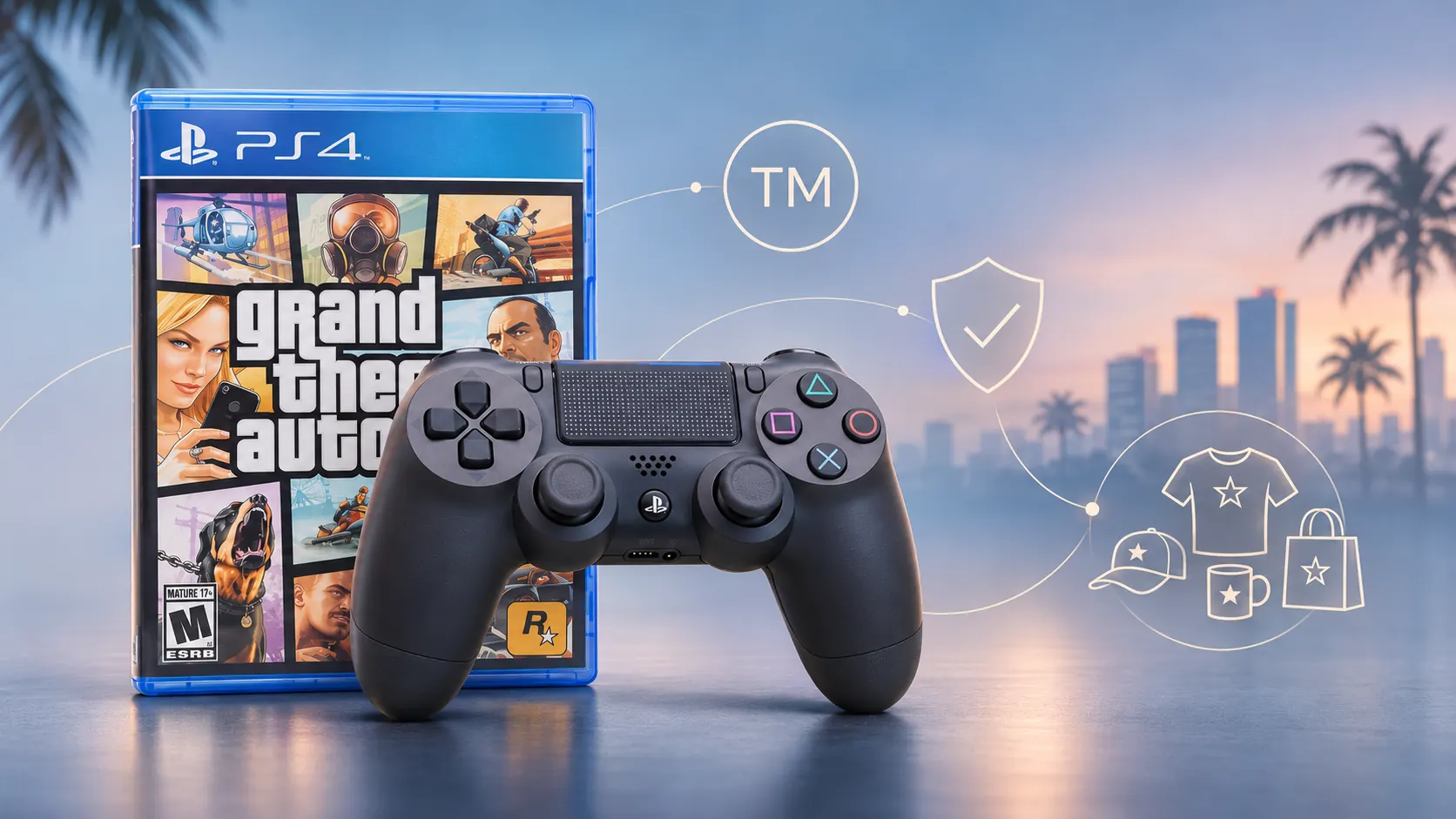

After more than 13 years of anticipation, Grand Theft Auto VI (GTA VI) is now available. The new video game from Rockstar Games launched on November 19 for PlayStation 5 and Xbox Series X|S. Beyond the excitement surrounding the release, there is another aspect that deserves attention: the industrial and intellectual property strategy that protects the GTA universe.
In the video game industry, brands no longer protect just the name of the game, but the entire universe surrounding it. Take-Two Interactive, the parent company of Rockstar Games, has been registering the elements that make the franchise recognizable for more than twenty years. And this is no coincidence. For a video game company, cities, characters, and settings are assets with value of their own.
Vice City and the New Brands in GTA VI
To understand this strategy, we need to look back at previous installments. Take-Two has not only registered the name “GTA” and the Grand Theft Auto cover art; it has also protected other elements of the game’s universe, such as the word marks “SAN ANDREAS” and “LOS SANTOS,” with the European Union Intellectual Property Office (EUIPO). Of particular note is Vice City, the Miami-inspired city that serves as the main setting for GTA VI and had already played a prominent role in the series long before this release. Take-Two applied for the word mark “VICE CITY” in 2002 and, in 2009, registered the figurative mark “VICE CITY STORIES,” the title of a previous video game set in that city. With GTA VI, the company has continued to expand this protection: in October 2026, it filed applications for “VICE CITY LEONIDA,” which links the city to the fictional state where the game takes place, and for “MACCA THE GATOR,” a pink alligator from its universe.
In addition, in September, Rockstar announced a collector’s edition inspired by Vice City and Leonida, and on October 8, it released its official GTA VI merchandise collection, featuring T-shirts, hats, bags, and other items. All of this shows that elements of a video game can have a commercial life of their own beyond the game itself, which makes it necessary to decide which trademarks should be protected and how to do so.
Why register trademarks for merchandise if they're already protected for video games?
When designing a protection strategy, it is important to keep in mind the two aspects of a trademark. Registration grants an exclusive right to use the mark and, at the same time, to defend it against third parties who seek to register or use identical or similar marks under circumstances that could infringe on the owner’s rights.
This is where the principle of specialty comes into play. A registered trademark grants an exclusive right to the mark and prevents others from using or registering identical or similar marks. However, as a general rule, that protection is limited to the goods for which it was registered. Therefore, having “VICE CITY” registered for video games is not enough to control the use of the mark on a mug or a T-shirt. That is why companies extend their registrations to the goods they plan to market.
However, registration protection entails a requirement of use If the trademark is not actually used for the protected goods or services, once the legally prescribed period has elapsed—which varies by jurisdiction—the registration may become vulnerable to a cancellation action for nonuse. Furthermore, lack of use can weaken the owner’s position when attempting to enforce the trademark against third parties—for example, in an opposition proceeding or an infringement action—since the owner may be required to prove such use.
This aspect should be given special consideration in relation to merchandising. It does not always make sense to proactively protect a trademark for a very broad range of goods if there is no reasonable expectation of marketing them. Excessively broad protection may be useful from a defensive standpoint during the early years, but it loses much of its effectiveness once the registrations become subject to the requirement to prove actual use.
Therefore, before registering a trademark for new product categories, it is advisable to analyze which items you actually plan to market, under which mark, and within what timeframe. The goal is to strike a balance between sufficiently broad preventive coverage and a portfolio that can subsequently be sustained through effective use. And, of course, it is essential to investigate in advance whether the mark is registrable, taking into account absolute grounds for refusal and/or third-party rights to identical or similar names.
Copyright as Protection for the GTA VI Universe
There is also another tool that is often overlooked. The design of a character such as “Macca the Gator,” its illustration, or other creative elements of the game may be protected by copyright if they are original.
In some cases, certain titles or names may also be protected, although such protection is more exceptional. In such cases, protection does not depend on whether the element is registered as a trademark, nor is it subject to the same requirements regarding use. It may be invoked both against the unauthorized use of the work and against third-party trademark applications that reproduce or imitate it.
This approach, however, has its own challenges. Since there is no official registration requirement, in the event of a dispute, it will be necessary to prove authorship, ownership of the rights, and the originality of the work. For this reason, it is advisable to keep documentation of the creative process and to ensure that contracts with creators or illustrators expressly assign the rights to the characters—and not just to specific illustrations.
A protection strategy that extends beyond borders
Companies must also remember that trademark rights are territorial. What Take-Two applies for in the United States protects it only there—not in Spain or the rest of the European Union. Therefore, when a company sells its products in multiple countries, it must analyze in which markets it needs to protect its marks and which registration routes are most suitable for it.
Protecting the GTA VI Universe: Trademarks and Copyrights
The case of GTA VI illustrates how trademark protection can extend beyond the video game itself to include cities, characters, and settings that have commercial value of their own.
The most sound strategy is to selectively combine both approaches. On the one hand, register trademarks for products and territories where there is, or will be, actual commercial use. On the other hand, leverage copyright protection for the creative elements of the work.
At ELZABURU, we advise companies and creators on the identification, registration, management, and protection of their industrial and intellectual property assets, designing protection strategies tailored to their projects and business objectives.
Sara García, attorney in the Trademark Practice Group at ELZABURU.