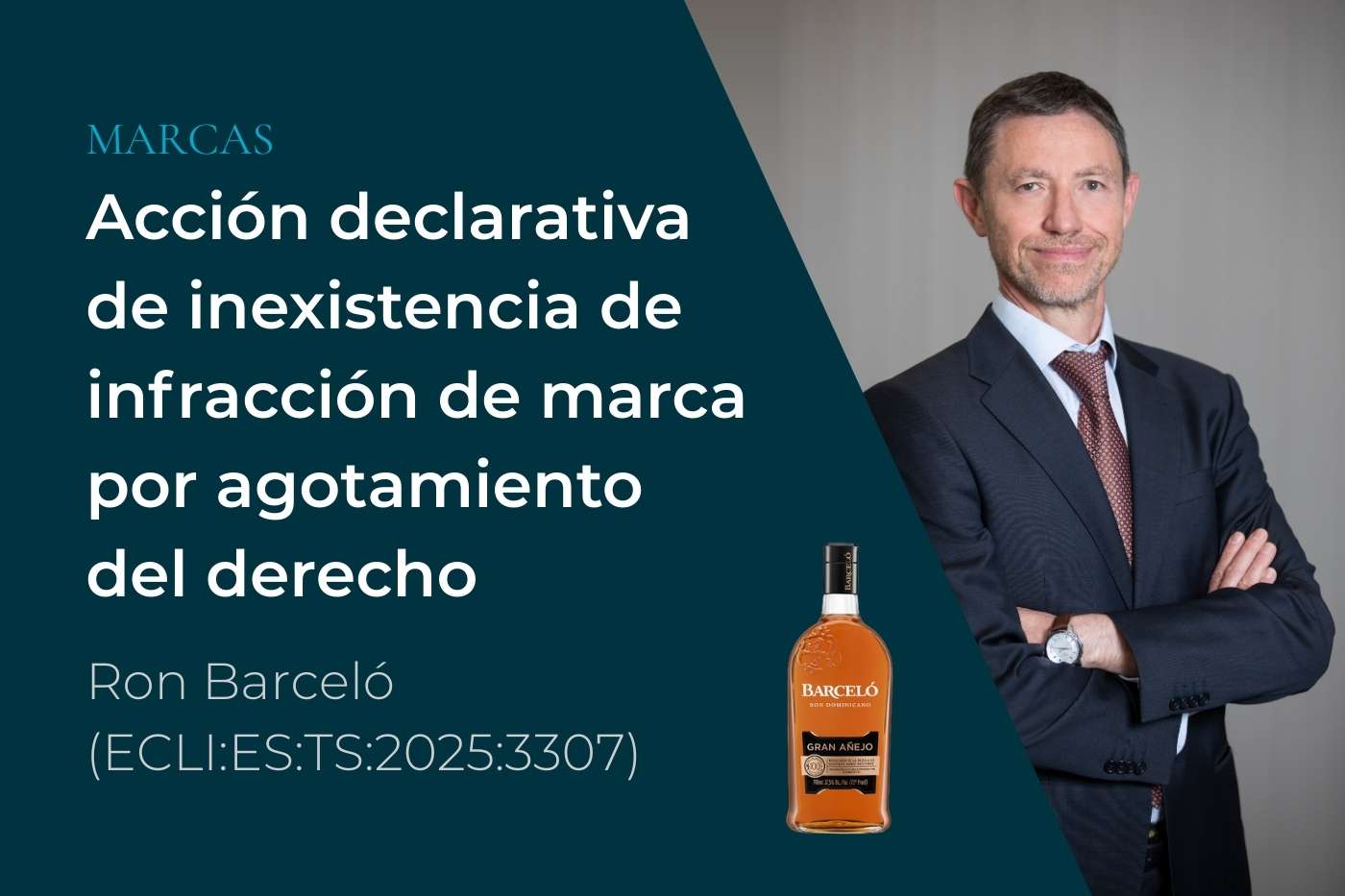

Supreme Court Decision of June 30, 2025, Ron Barceló (ECLI:ES:TS:2025:3307)
1. Facts
Several beverage distributors filed a lawsuit against Barceló Comercial Internacional, S.A. and Importaciones y Exportaciones de Varma, S.A., seeking a declaration that these companies had acted unlawfully by asserting their rights to the “Ron Barceló” trademark to prohibit the sale of products bearing that trademark within the European Economic Area (EEA), thereby engaging in acts of unfair competition and violating European competition law. The plaintiffs sought a ruling that the purchase of “Ron Barceló” from EEA suppliers at prices lower than those set by Spanish distributors was lawful, since, as the goods originated in the EEA, the rights to the “Ron Barceló” trademark would have been exhausted.
The defendants contested the complaint, arguing that the right had not been exhausted, and filed a counterclaim alleging trademark infringement of the “Ron Barceló” trademarks in connection with the plaintiffs’ sales of products bearing that trademark without their authorization.
At first instance, the European Union Trademark Court No. 1 in Alicante issued a judgment dismissing the complaint in its entirety and granting the counterclaim. On appeal, the 8th Chamber of the Provincial Court of Alicante (European Union Trademark Court) essentially upheld the first-instance judgment, with some modifications to the content of the ruling.
The Provincial Court held that, although the complaint did not refer to it as such, the action brought therein was an action to deny infringement of the Ron Barceló trademark. Although this action is not regulated by the Trademark Law, it is provided for in Article 121.1 of the Patent Law, which the Court considers applicable by virtue of the reference set forth in the First Additional Provision of the Trademark Law. However, it dismissed the action because it found that the circumstances necessary for trademark right exhaustion to occur were not present in this case.
The plaintiffs filed an extraordinary appeal on grounds of procedural error and a cassation appeal against the appellate court’s decision, both of which were dismissed in their entirety by the decision discussed in this commentary.
2. Statements
In their appeal, the plaintiffs raised several grounds for cassation concerning the issue of the trademark owner’s consent to the marketing of products bearing the trademark within the EEA and the burden of proof regarding the existence of trademark exhaustion.
The Supreme Court, drawing on the extensive case law of the Court of Justice of the European Union on exhaustion, begins by noting that, as a general rule, the Court of Justice holds that the trademark owner has granted consent to the marketing of its products within the EEA when it has been able to control the marketing of the products by third parties, since such control serves to safeguard the essential function of the sign as an identifier of the product’s commercial origin.
Furthermore, the Supreme Court acknowledges that consent may be implied, but emphasizes that the Court of Justice has held that, in order to establish the existence of such implied consent, certain prior, concurrent, or subsequent elements and circumstances must be present that clearly indicate the trademark owner’s waiver of the right to assert its exclusive rights. In this case, the Supreme Court agrees with the Provincial Court that such certainty does not exist.
With regard to the burden of proof, the appellants invoked the case law of the Court of Justice, which establishes a reversal of the burden of proof in cases where placing that burden on the alleged infringer allows the trademark owner to compartmentalize national markets—as may occur when the owner markets its products in the EEA through an exclusive or selective distribution system.
The Supreme Court reviews the rulings of the General Court on this issue and notes that the burden of proof regarding exhaustion varies depending on whether the place of first commercialization of the product is known: if it is unknown and there is a risk of market partitioning, the burden of proof falls on the trademark owner and not on the parallel importer; conversely, if it is known from the outset that the product was first placed on the market outside the EEA and the trademark owner can prove this, there is a presumption that the owner has not consented to the subsequent entry of the products into the European market, and it is up to the parallel importer to prove that such consent was given.
Based on these premises, in the case at hand, the Supreme Court dismisses the plaintiffs’ appeal, as it finds that they are raising a preliminary issue, since it was not proven at the lower court that Ron Barceló is distributed under an exclusive distribution arrangement or that there is a risk of market partitioning.
Finally, the Supreme Court also rejects the ground for appeal that argued that the fact that a distributor from the EEA was identified on the products’ original labeling should be considered decisive evidence of the existence of tacit consent. The Court considers that this could be an indication to be taken into account along with others to reach a certain standard of proof regarding consent, but that on its own it is not sufficient to establish the existence of tacit consent.
3. Comment
The significance of this ruling lies in its confirmation of the possibility—recognized on appeal by the 8th Chamber of the Provincial Court of Alicante—of filing a declaratory action for non-infringement (an action for negation or a boast) in trademark matters, equivalent to that provided for in Article 121.1 of the Patent Law.
In this regard, the reference to the regulation set forth in that provision has significant consequences, including the requirement to comply with the condition of prior notice to the right holder, as provided in the second paragraph of the article. In this case, one of the reasons the Provincial Court had dismissed the action to deny ownership was the failure to comply with this requirement, and this ruling is upheld by the Supreme Court.
Furthermore, this ruling is particularly interesting in terms of its analysis of two essential aspects of the doctrine of trademark exhaustion. First, the possible existence of tacit consent by the rights holder for the product’s sale within the EEA, and the conditions that must be met for the courts to assess it. And second, the burden of proof regarding exhaustion and the possible situations in which there may be a reversal of the general principle of civil procedure, under which the burden of proof for a fact rests with the party asserting it.
As might be expected, in examining these issues, the Supreme Court draws upon the Court of Justice’s extensive case law on parallel imports between Member States and the principle of trademark exhaustion.
Carlos Morán, Partner, Legal Department