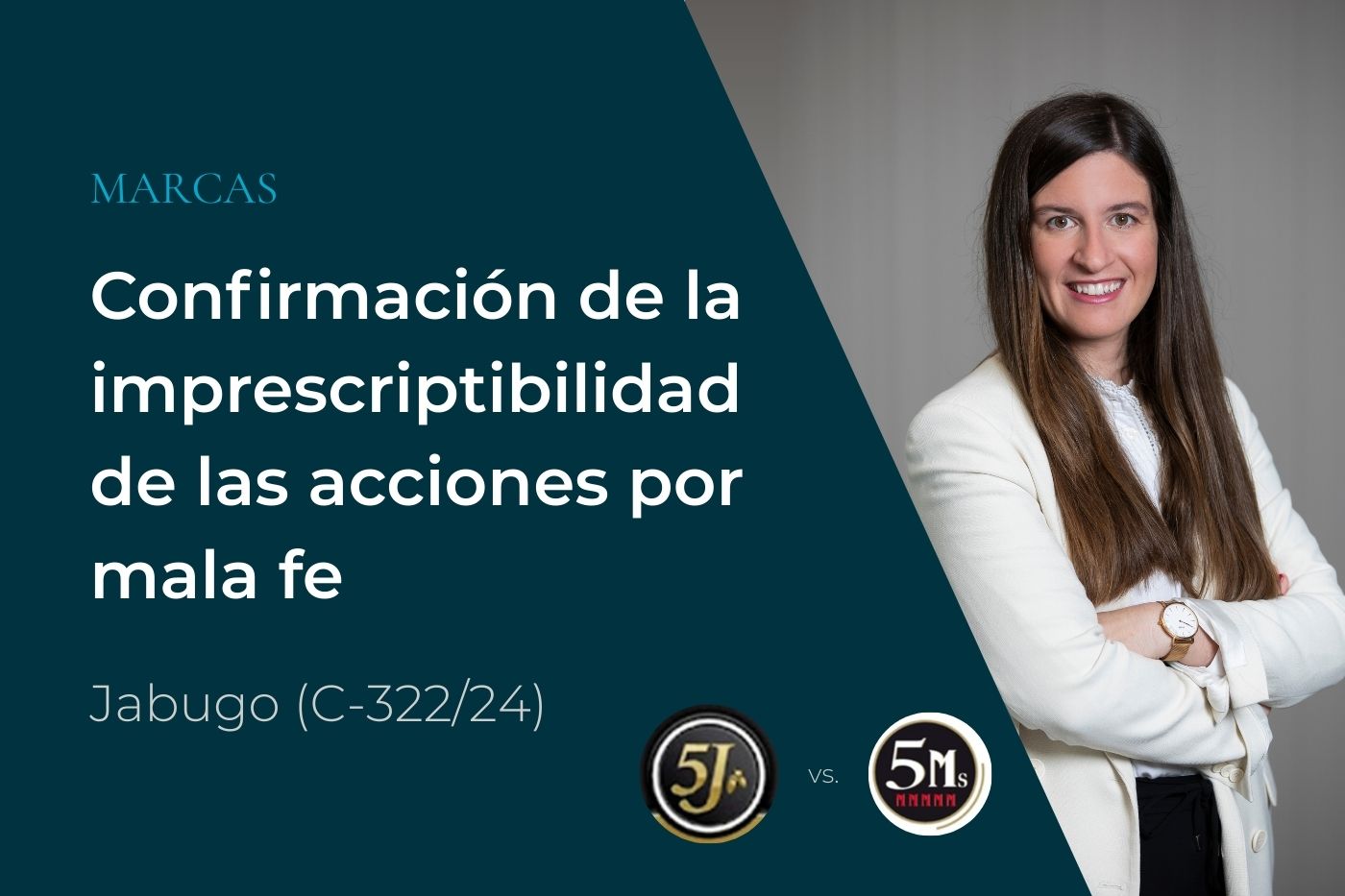

Judgment of the Court of Justice of July 10, 2025, Jabugo (C-322/24)
1. Facts
Sánchez Romero Carvajal is the owner of the following EU trademarks in Class 29:

For its part, Embutidos Monells is the owner of the following Spanish national trademarks, also in Class 39:

In 2016, Sánchez Romero Carvajal issued a formal notice to Embutidos Monells urging it to renounce the registration of the disputed trademarks and to cease using the figurative mark “5Ms.” That formal notice stated that Embutidos Monells was aware of the reputation of the “5J” trademark owned by Sánchez Romero Carvajal, since, as a result of the opposition filed by the latter, the Spanish National Institute of Industrial Property (OEPM) had refused to register the “5Cs” mark.
The notice also specified that Sánchez Romero Carvajal could file an action for annulment against the 5Ms and 5Ps registrations, respectively, by February 28, 2017, and by March 18, 2017.
However, the action for annulment before Commercial Court No. 1 of Alicante was not filed until 2021.
Embutidos Monells invoked the defense of acquiescence, arguing that the registration of the disputed trademarks dated back to 2012, meaning that Sánchez Romero Carvajal had long acquiesced to their use, and that the deadlines specified in the extrajudicial notice had expired.
In this context, Commercial Court No. 1 of Alicante decided to suspend the proceedings and refer a preliminary ruling to the Supreme Court regarding the potential effects of specifying time limits in said notice.
Specifically, the question is whether the fact that Sánchez Romero Carvajal had specified in an extrajudicial notice a time limit for bringing an action for annulment—which coincided with the five-year statute of limitations established in the Directive—should be considered binding conduct that precludes a subsequent claim of bad faith in seeking annulment after that time limit has expired.
Second, if the answer is yes, the question is whether Sánchez Romero Carvajal’s filing of an opposition against the registration of other, later European Union trademarks owned by Embutidos Monells that are nearly identical (1) can be considered a reasonable effort to remedy the situation within a reasonable time frame, thereby interrupting the statute of limitations.

2. Statements
The Supreme Court ruled that the owner of an earlier trademark is not bound by the deadlines set forth in an out-of-court notice when it comes to alleging bad faith in the registration of a later trademark. If the owner of the earlier trademark has sufficient evidence of bad faith at the time of the notice, he or she may continue to assert invalidity on the grounds of bad faith even after the deadline has expired.
Consequently, if the grounds on which the action for invalidity is based consist of bad faith on the part of the owner of the later trademark when filing the application for registration of that trademark, the latter cannot, in order to defeat that action, validly invoke the doctrine of acquiescence, as set forth in Article 9(1) of Directive 2008/95, against the owner of the earlier trademark.
However, the Court notes that, since good faith is presumed, it is the party alleging bad faith that must prove its existence during the examination of the merits of the action.
In light of the answer given to the first preliminary question, there is no need to answer the second.
3. Comment
The ruling in this case is highly significant because, in addition to following the Court of Justice’s previous case law on bad faith—from the ruling in Chocoladefabriken Lindt & Sprüngli (C-529/07) to HEITEC ( C-466/20)—it serves to reinforce the principle that statutes of limitations should not prevent the exercise of rights when there is bad faith in the application for trademark registration.
The owner of an earlier trademark may issue an out-of-court demand specifying deadlines for filing an action for invalidation, which may lead the recipient to reasonably believe that, once that deadline has expired, no legal action will be taken. Although this could be interpreted as binding conduct on the part of the sender of the notice, the Supreme Court has held that this reliance cannot override the lack of a statute of limitations for an action for invalidation based on bad faith.
This ruling is significant because it strengthens the system of fair competition in the European Union, thereby protecting owners of well-known trademarks against the misappropriation of identical or similar distinctive signs by competitors acting in bad faith.
Marta Rodríguez, Associate Partner, Trademarks Practice Group