
A major innovation doesn't always stem from a radically new idea. Sometimes, the real breakthrough lies in changing a package, transferring a technology from one industry to another, paying attention to how consumer needs evolve, or overcoming a technical limitation that seemed inevitable.
The history of many everyday or world-renowned inventions shows that success rarely depends on a single moment of inspiration. Between the invention and its arrival on the market, there are decisions related to design, protection, branding, communication, user experience, and the ability to continue evolving. And some of these decisions, though they may seem minor, ultimately determine the future of innovation.
LEGO: When a Patent Ends Up Creating Much More Than Just a Product
In 1958, LEGO patented the interlocking system for its well-known bricks. The technical solution was crucial: it allowed the pieces to be firmly connected and, at the same time, separated so they could be reused over and over again.
But reducing the history of LEGO to that single invention would leave out much of what explains its subsequent development.
Over time, the company stopped focusing its messaging solely on the structures that could be built with its pieces and began to shift its focus to something much broader: imagination, creativity, and the nearly infinite possibilities of play.
The product remained essentially the same. What changed was the way value was built around it. The brand, its positioning, and the way consumers perceive the product can extend, transform, and multiply the value of the initial idea.

The toothpaste tube: an innovation hidden in the packaging
Today, it's hard to imagine toothpaste outside of its tube. However, in the late 19th century, it was commonly sold in glass jars that were shared by several members of a family.
The change came about in 1892, when Washington Sheffield noticed the tubes used to hold oil paint and began using them to package toothpaste. This change made the product more hygienic, allowed for better control of the amount dispensed, and simplified its use. The solution was later adopted by other companies and eventually became the standard format.
The toothpaste wasn't new. Neither was the tube. The innovation lay in combining two familiar elements in a new way.
This is a pattern that constantly repeats itself in innovation: looking outside one’s own industry can reveal solutions that have been working for years in other contexts and that, when applied to a new need, completely transform the user experience.

The Roll-On: When a Pen Inspires a New Way to Apply Deodorant
Something similar happened with another item we use almost without thinking: roll-on deodorant.
Its mechanism is based on a simple principle. A ball rotates, picks up a certain amount of liquid, and spreads it over a surface. It’s the same logic that led to the development of the ballpoint pen.
When applied to the field of personal hygiene, this technology solved a different problem and led to a new way of using the product.
Nylon stockings: Innovation also means knowing how to change
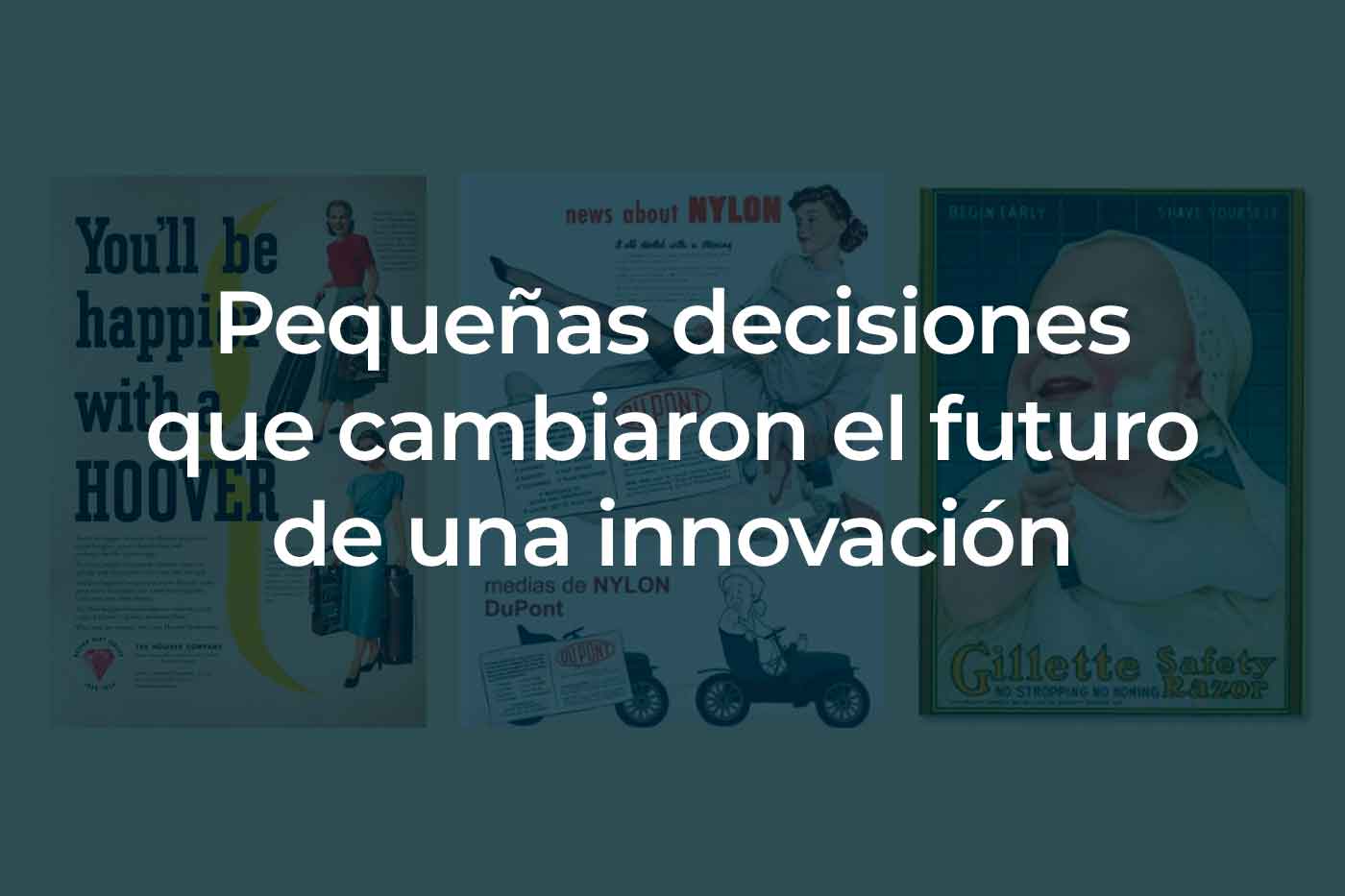
When they first appeared on the market, nylon stockings stood out for properties that represented a significant improvement over previous alternatives: they were durable, elastic, and performed well.
However, female consumers began to seek out stockings that were thinner, more sheer, and more aesthetically appealing. Durability was no longer the only decisive factor. The product evolved to meet these new preferences, and its advertising also changed, gradually shifting from emphasizing durability to placing greater importance on appearance.
This example shows us how a good product is only part of the journey. Observing how the market changes, identifying new expectations, and adapting both the solution and its positioning can be just as important for maintaining its relevance.

Gillette: Inventing a Product and Teaching Consumers How to Use It
King C. Gillette developed a double-edged disposable razor that offered a new way to shave comfortably at home. However, introducing an unfamiliar technology to the market also means educating consumers and showing them the benefits of changing their habits.
Gillette combined the product with educational advertising, easily recognizable packaging, and promotions that made the razor more accessible. The technical innovation was thus accompanied by a marketing and communications strategy designed to help consumers understand a new way of shaving.

Dunlop: Solving a Small Problem and Ending Up Transforming an Industry
John Boyd Dunlop developed a pneumatic tire in an effort to make his son's tricycle rides more comfortable. The solution initially addressed a very specific need, but it quickly evolved, and its application expanded to bicycles, motorcycles, and automobiles.
Although its commercial and technological success was undeniable, it was discovered years later that Robert William Thomson had already patented a similar idea in 1845, which led to the invalidation of several of Dunlop's patents on the grounds of lack of novelty.
IMAX and The Odyssey: Innovating by Removing the Barrier That Was Holding Us Back
On other occasions, innovation arises because there is an extraordinary technology that cannot yet be used as intended.
Christopher Nolan had wantedto shoot an entirefilm in 70 mm IMAX format for years. The image quality made it particularly appealing, but the cameras posed significant challenges: their size and, above all, the noise they generated made them difficult to use throughout an entire shoot—especially in scenes with dialogue.
For *The Odyssey*, IMAX worked for two years alongside the director and his director of photography to develop a new generation of cameras capable of overcoming those limitations.
The new camera incorporated materials from industries such as aerospace and Formula 1 to reduce weight, a redesigned film transport mechanism to minimize noise, a digital interface to monitor its operation, and a new acoustic shielding system that reduced noise and vibrations.
In this case, the goal was not to question the existing technology, but rather to identify what was preventing us from taking it a step further and to focus our efforts specifically on overcoming that barrier.

What if the best decision is to change almost nothing?
The paper clip, the Allen wrench, the zipper, the measuring tape, the coat hanger, the egg carton, and certain types of whistles have been solving essentially the same problem in very similar ways for decades (in some cases, for more than a century).
Materials, industrial processes, and small details have changed. Its basic principle, however, remains the same.

And perhaps there's another lesson there about innovation. Evolving doesn't mean constantly modifying a product just because it's possible to do so. Sometimes, a solution is so well-suited to the problem that the best decision is to preserve what works.
Managing innovation means deciding what to protect, what to transform, and what to preserve
These examples are based on very different objects and technologies, but they share a common idea: the future of an innovation is not determined solely at the moment someone invents it.
It may depend on packaging that enhances the user experience, on technology imported from another industry, on the ability to adapt to new preferences, on a branding strategy that broadens the product’s meaning, or on a technical improvement that removes the final obstacle to making something possible that wasn’t before.
For this reason, managing innovation requires a broader perspective than simply protecting an invention in isolation.
At ELZABURU, we approach intangible assets from this perspective: analyzing not only how to protect them, but also how to defend them, leverage them, and develop them in line with each organization’s strategy. Patents, designs, trademarks, intellectual property rights, trade secrets, and know-how can all be part of the same framework for protection and value creation.
Because a good idea can open a door. But it’s the decisions made around it that often determine how far it can go.