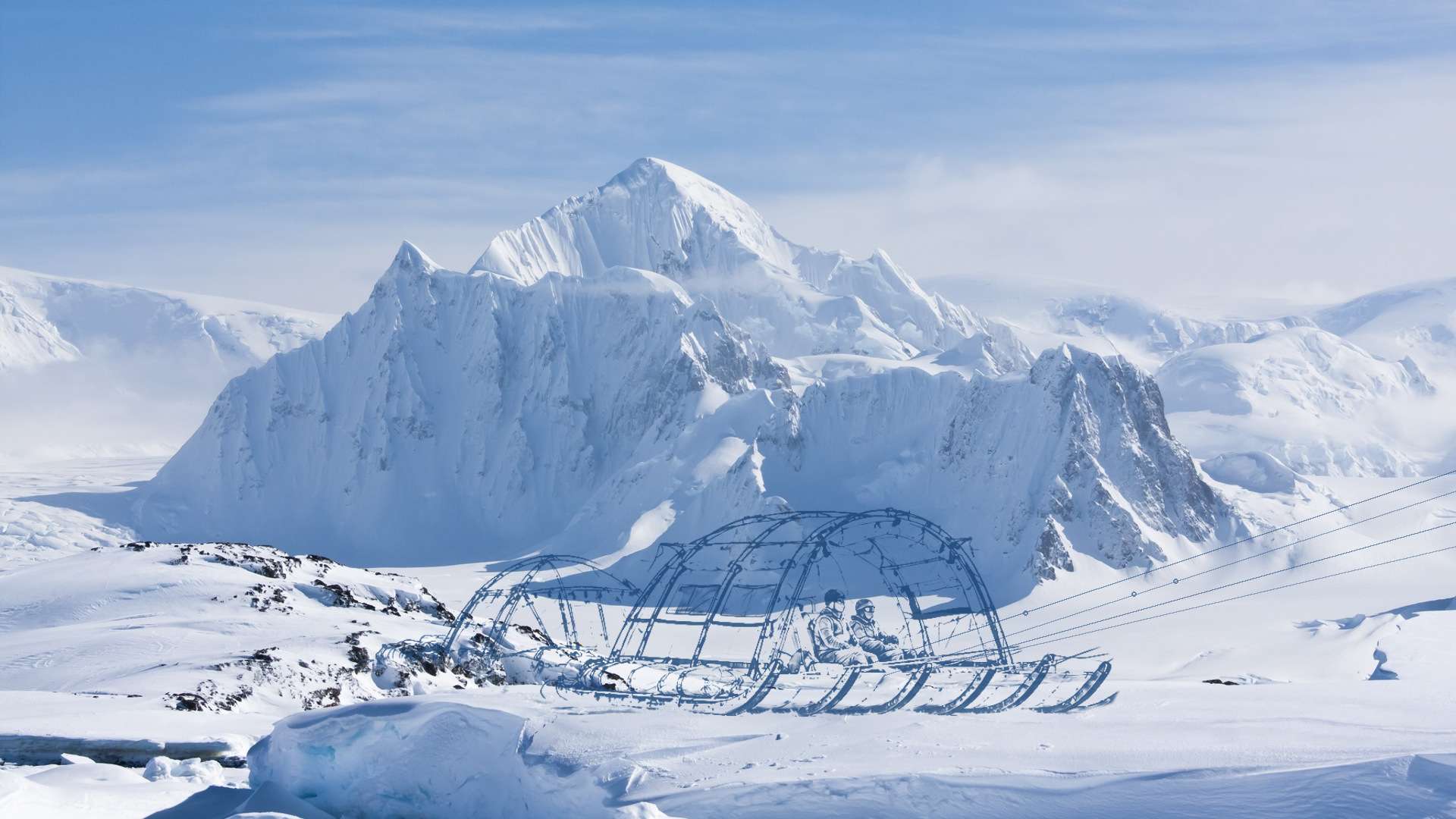

A 15-meter sled, pulled by large kites, is preparing to travel 3,400 kilometers across the Antarctic interior with a scientific laboratory on board. This is the latest challenge for Spanish explorer Ramón Larramendi, who has spent more than 25 years developing a vehicle capable of traveling through the polar regions in a sustainable manner, using only the power of the wind.
His invention, known as Wind Sled, is a polar vehicle that combines the traditional knowledge of the Inuit peoples with technical solutions developed and refined over the course of numerous expeditions. This Spanish innovation also has a history linked to industrial property and ELZABURU, which helped protect it through a utility model registered in Spain.
An 80-day, 3,400-kilometer Spanish expedition to study Antarctica
The Trineo de Viento Antarctica 2026–2027 expedition is a Spanish initiative and has been coordinated by the Spanish Polar Committee, a body under the Ministry of Science, Innovation, and Universities. It plans to spend approximately 80 days exploring one of the most remote regions on Earth—Antarctica—with the goal of demonstrating that it is still possible to learn from this place.
During the expedition, ice samples will be collected, the presence of microplastics and other contaminants will be studied, and aspects related to climate change will be analyzed. All of this will take place in areas that are particularly difficult to reach using conventional means of transportation.
And this is where the star of the project comes into play: the wind-powered sled. It will be used to travel across the ice without using fossil fuels for propulsion, relying solely on the wind, which makes it the polar transportation system with the lowest environmental impact.
But the sled will not only be used as a means of transportation to complete the journey; it will also serve as a mobile scientific laboratory, from which 16 research projects will be carried out, with the participation of institutions such as the CSIC, CIEMAT, NASA, and various universities. Added to this is the use of solar energy to power the scientific equipment, so we could say that this is one of the most sustainable polar expeditions.
How does Ramón Larramendi's Wind Sled work?
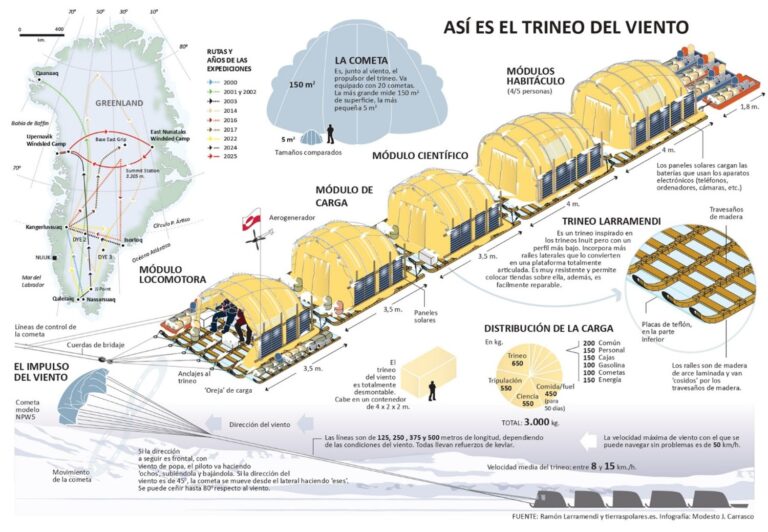
At first glance, the vehicle looks like a cross between a giant sled and a camp on the snow. The tents used by the crew and the equipment needed for the expedition are set up on its platforms.
The model built for this journey has four articulated modules, is about 15 meters long, and can carry up to 2,100 kilograms of cargo.
One of its unique features is the way it is constructed. The skates are made of laminated wood and are connected by crossbars and a system of rope fastenings. This structure has the flexibility needed to adapt to the unevenness of the ice, without concentrating all the stress at a single point.
It is especially useful for traversing sastrugis—formations of hardened, wind-sculpted snow that create ridges and uneven terrain on the Antarctic surface. Its construction, which consists of relatively simple parts and joints, also makes it easier to repair in the field, where replacing a component can be much more practical than trying to fix a complex mechanism.
The craft is propelled by large kites that function much like a ship's sails. The crew can adjust their position and altitude to take advantage of air currents and adapt the thrust to the current conditions.
For this expedition, 20 kites ranging in size from 5 to 150 square meters have been prepared; they will be used depending on the direction and strength of the wind.
This system has its origins in the traditional Inuit sleds that Larramendi encountered during his travels in the Arctic. From them, he drew inspiration for a sturdy yet flexible structure, which he later adapted to be propelled by kites and to carry much heavier loads.
From Invention to Utility Model: The Protection of the “Trineo de Viento” in Spain
The Wind Sled hasn't always been as we know it today. Ramón Larramendi began developing it between 1999 and 2000, and since then, he has built ten prototypes that he has tested on various expeditions. From the first tests in the Pyrenees to Canada and Greenland, each journey has allowed him to make improvements.
The tenth prototype is considered the definitive model of the Wind Sled, particularly because of its versatility and the ability to adapt it to different configurations depending on the needs of each expedition.
At ELZABURU, we had the opportunity to help protect the technology developed for the Wind Sled by filing a utility model application in Spain. Our colleague Pedro Saturio Carrasco was responsible for drafting the application and defining the strategy for protecting the invention:
“From that first version we built more than 25 years ago to the current vehicle, there has undoubtedly been a significant evolutionary leap. However, the latest version retains the original concept and its main elements and features. More importantly, it also maintains its original goal of serving science and polar exploration while preventing environmental pollution.”
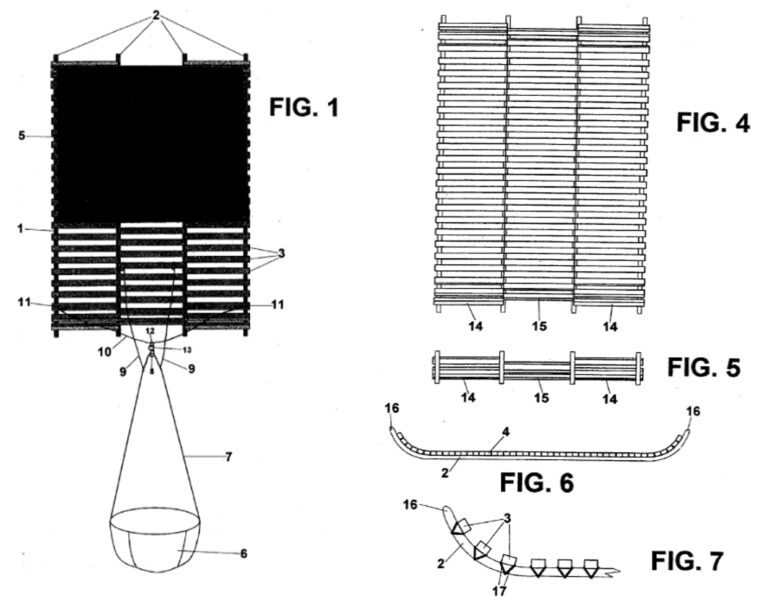
Figures included in the utility model application
A utility model is a form of industrial property that provides protection for technical solutions that offer a practical advantage to a product—for example, through a configuration or structure that improves its performance or usability.
It is a particularly interesting avenue for certain mechanical developments and functional improvements. And the case of the Wind Sled illustrates how, behind a seemingly simple idea, there can be considerable technical work that deserves to be recognized and protected.
More than 25 years later, that idea continues to evolve and face new challenges. The upcoming expedition to Antarctica is a testament to how far an invention can go when ingenuity is combined with years of work, testing, and refinement. It also reminds us that innovation doesn’t always mean inventing something completely new, but rather finding a different way to solve a problem. And that protecting those solutions is part of the journey that allows an idea to keep reaching farther and farther.
Elisa Prieto, Head of Knowledge, and Pedro Saturio, Associate Partner in the Patent Practice at ELZABURU