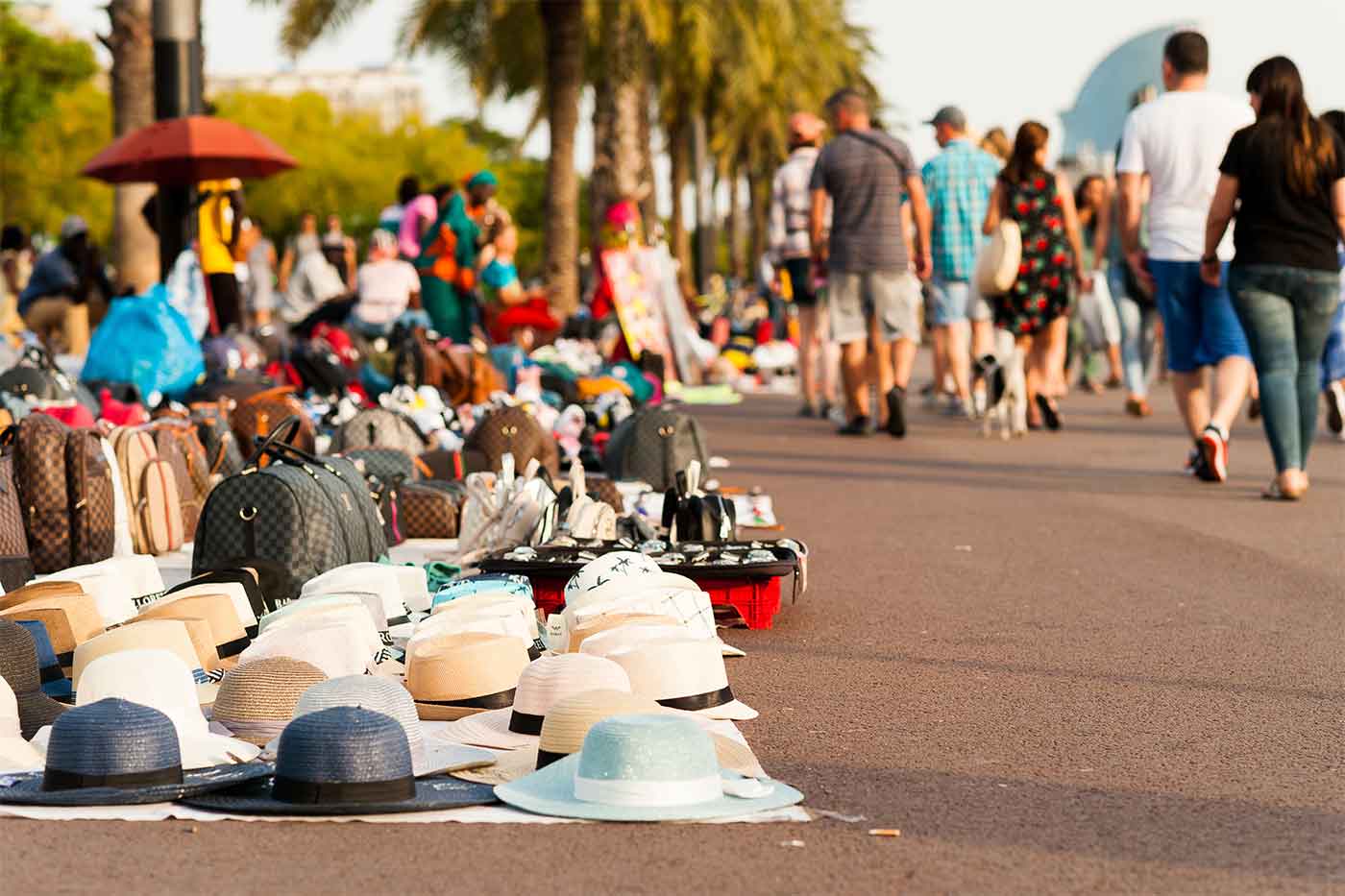

According to a recent report, Spanish companies in sectors such as fashion, cosmetics, and pharmaceuticals are losing “more than 10% of their revenue due to counterfeiting.” The problem is well documented. For example, in a report by The New York Timeson street vendors selling counterfeit goods in Barcelona, the newspaper highlighted the significant challenges faced by the police in curbing these activities in Spain. As a result, vendors selling counterfeit goods are common in various parts of the country, especially in areas with high tourist traffic.
Below, we share the most effective way for brands to combat the sale of counterfeit products in Spain, as well as highlight some of the markets that rights holders should keep on their radar.
What should a rights holder know about anti-counterfeiting enforcement in Spain?
Enforcing intellectual property rights against counterfeiting in Spain requires an understanding of the country’s legal framework, which is aligned with European Union regulations and international agreements. Rights holders seeking to take action against counterfeit products in physical markets must be familiar with both the legal framework and the practical steps to follow.
Trademark infringement cases are primarily prosecuted through criminal proceedings, although trademark owners may also file civil suits, either independently or in conjunction with the criminal proceedings.
According to Article 274 of the Penal Code, trademark counterfeiting is punishable by imprisonment for six months to four years, with the possibility of up to six years in the most serious cases. Fines vary depending on the severity of the offense. Although trademark counterfeiting is classified as a public offense—which allows authorities to take action without the need for a formal complaint— it is recommended that rights holders file a complaint. This enables authorities to gather the necessary evidence, increasing the chances of a successful prosecution.
Once a criminal complaint has been filed and proceedings have begun, the trademark owner may choose to participate in the proceedings as a private prosecutor (which allows the owner to access evidence, present their own evidence, and appeal decisions) or leave the prosecution in the hands of the Public Prosecutor’s Office, which limits the owner’s participation and control over the case.
Are property owners liable in Spain?
The liability of property owners will depend on the extent of their involvement in and/or knowledge of the violation committed on their properties.
In the first instance, according to the Spanish Penal Code, property owners bear no liability. However, if it is proven that they were aware of these activities, they could be considered instigators, necessary accomplices, accomplices, or accessories after the fact.
Since their knowledge of the violation could make them liable, it is advisable to notify them of any illegal activity on their properties and to hold them liable in such cases, as recognized in the July 7, 2016, ruling of the Court of Justice of the European Union in Delta Centre (C-494/15).
Are there any organizations dedicated to combating counterfeiting in Spain?
ANDEMA (Association for the Defense of Trademarks) is Spain’s leading association of intellectual property rights holders. Founded in 1989, its primary function is to represent companies before government agencies to defend their trademark rights against infringements. It currently has 100 member brands from various sectors and countries.
5 Key Points About Counterfeiting in Spain
1. La Jonquera and Els Límits – Le Perthus (Girona)
- Location: La Jonquera, 17700, Girona.
- Does the market or area have a website with contact information? No.
- Risk level: very high.
- Counterfeit products: clothing, footwear, and fashion accessories.
- Law enforcement challenges in this market: Despite all the police operations carried out in this area, it remains one of the places where the most counterfeit goods are sold in Spain. Its strategic location on the border with France makes it difficult to combat counterfeiting due to the high volume of commercial traffic. Another added problem is the need for trademark owners to provide logistical support to law enforcement authorities, such as transportation, storage, and destruction of counterfeit products.
- Recommendations for trademark owners: work together with other affected trademark owners and coordinate with the police and the Public Prosecutor's Office.
2. Cobo Calleja Industrial Park (Madrid)
- Location: Cobo Calleja Industrial Park, 28947, Fuenlabrada, Madrid.
- Does the market or area have a website with contact information? Yes, at this link.
- Risk level: very high.
- Counterfeit products: mainly clothing, handbags, shoes, sporting goods, cell phone accessories, electronics, and toys.
- Law enforcement challenges in this market: The Cobo Calleja Industrial Park is one of the largest industrial parks in Europe and a major logistics and distribution hub in Spain. It is home primarily to wholesale warehouses operated by Chinese importers, making it a hub for the import and distribution of products, many of which are counterfeit. One of the main problems is the enormous volume of goods moving in and out daily, which makes it difficult to monitor all products. In many cases, counterfeit goods arrive in large containers from Asia, hidden among legitimate products.
- Recommendations for trademark owners: Hire private investigators and conduct detailed preliminary investigations of establishments and warehouses to gather evidence of the activities taking place there.
3. PICA Business Park (Seville)
- Location: This industrial zone is located in Seville, and the facilities are managed by Chinese importers.
- Does the market or area have a website with contact information? Yes, at this link.
- Risk level: very high.
- Counterfeit products: clothing and electronics.
- Law enforcement challenges in this market: The Carretera Amarilla Industrial Park in Seville is a major industrial and commercial area in southern Spain. Although it does not have the same concentration of counterfeit goods as Cobo Calleja or La Jonquera, it remains a significant distribution hub. One of the main problems is the difficulty in identifying who is actually responsible for the stores, since often the person who appears to be in charge is merely an employee, while the actual owner remains hidden to avoid detection. Additionally, other challenges include difficulties in conducting investigations due to sellers’ distrust, as well as the sale of unbranded products and the separate sale of logos and trademarks for later affixing to products.
- Recommendations for trademark owners: hire private investigators and conduct thorough preliminary investigations of business premises and warehouses to gather evidence of the activities taking place there.
4. Badalona Sud Industrial Park (Barcelona)
- Location: An industrial park located south of Badalona (province of Barcelona). The businesses are run by Chinese importers who supply counterfeit goods to street vendors throughout Catalonia.
- Does the market or area have a website with contact information? No.
- Risk level: very high.
- Counterfeit products: mainly clothing, handbags, shoes, sporting goods, cell phone accessories, and toys.
- Challenges in law enforcement in this market: This industrial area is a key hub in Catalonia for the distribution of counterfeit products, most of which originate in Asia. The challenge here is the complex structure of the distributors and warehouses, which hinders inspections and raids. In many cases, the people listed as store owners are not actually the owners but are merely employees. Often, when stores are implicated in product counterfeiting—or believe they are under investigation— they change ownership, making it difficult to identify the true owners of the stores.
- Recommendations for trademark owners: Hire a private investigator to track down the sale of counterfeit goods, and once sufficient evidence has been gathered, file a complaint with the police.
5. Carrús Industrial Park (Elche, Alicante)
- Location: Located in the city of Elche (Alicante), this area is primarily managed by Chinese importers.
- Does the market or area have a website with contact information? No.
- Risk level: very high.
- Counterfeit products: clothing, handbags, shoes, sporting goods, electronic accessories, and toys.
- Law enforcement challenges in this market: There are clandestine workshops dedicated to the production of counterfeit footwear that pose a significant problem in the area. Although Elche is known for its legitimate footwear industry, the illegal trade has taken advantage of the local infrastructure to manufacture copies of well-known brands. Furthermore, as in other markets, there is mistrust toward investigators and a high volume of unbranded products to which logos are added after the sale.
- Recommendations for trademark owners: Hire a private investigator to track down the sale of counterfeit goods, and once sufficient evidence has been gathered, file a complaint with the police.
Alberto Gallo, Associate in the Legal andAnti-Piracy Department.