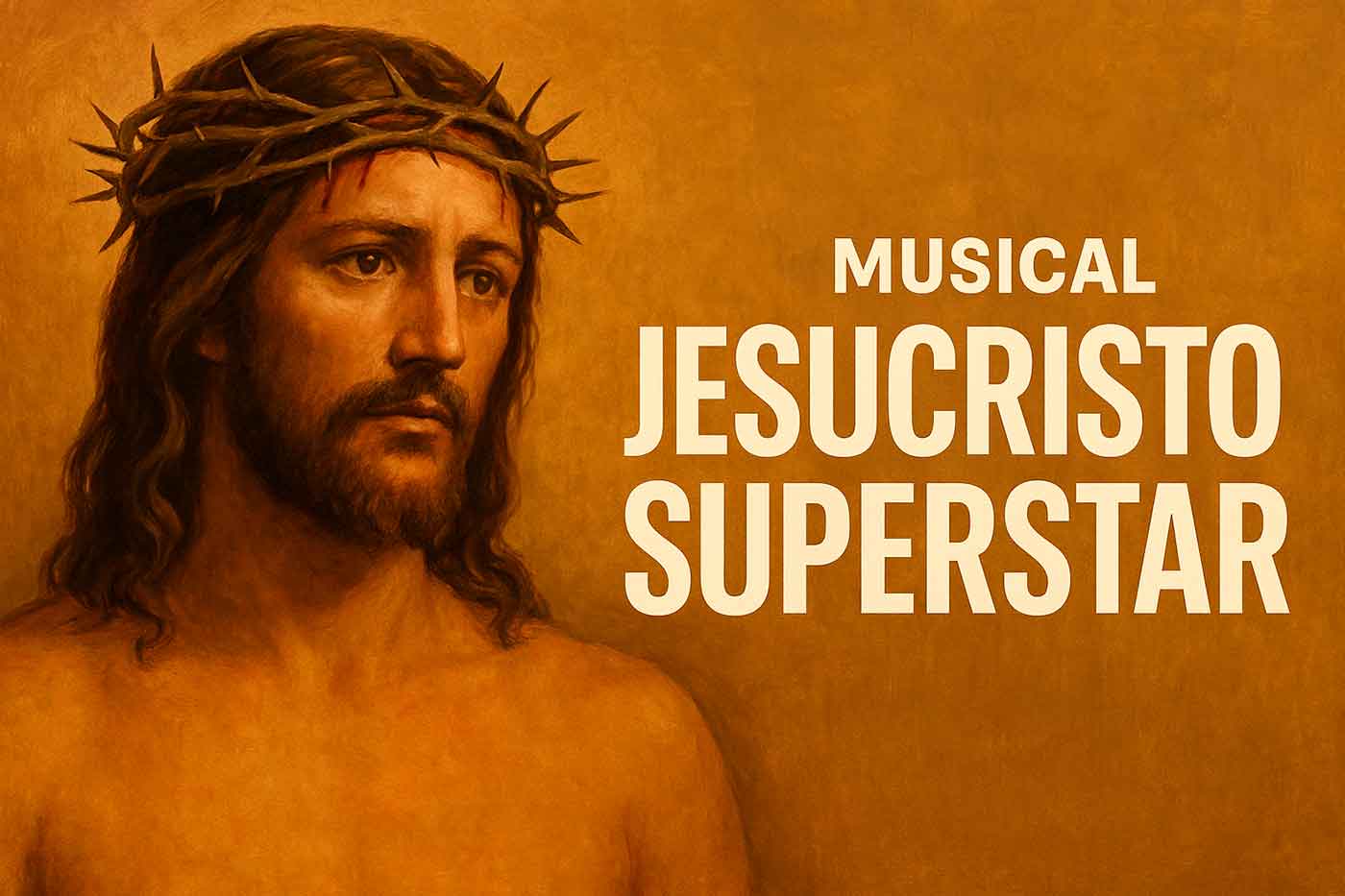
Did you know that on November 6, 1975, after four years in the making and overcoming all kinds of obstacles, the rock opera “Jesus Christ Superstar” premiered at the Alcalá Palace Theater in Madrid?
The musical, produced and starring Camilo Sesto throughout, had a huge impact on the world of culture and copyright in Spain at that time. Let’s look back at some of its milestones and lessons.
The Musical's International History
"Jesus Christ Superstar" was created in 1967 by the young Andrew Lloyd Webber and Tim Rice, and its commercial success followed a classic trajectory: first, it was recorded on an album (October 1970, featuring Ian Gillan of Deep Purple as the lead singer!); then it premiered on stage (Broadway in 1971, London in 1972); then it was made into a movie (1973); shortly thereafter, the movie’s soundtrack was released on record (1973); the musical then began touring the world with various productions and stage revivals that continue practically to this day; and finally, the title was registered as a European Union trademark (….)
His arrival in Spain
The musical’s reception in Spain, due to the political and market situation, was quite different. The film premiered at the Valladolid Film Festival on May 5, 1974, but did not reach commercial theaters until February 1975; the stage premiere took place in November of that same year; and the Spanish-language soundtrack, sung by the lead trio (Camilo Sesto, Teddy Bautista, and Ángela Carrasco), hit record stores during the Christmas season of 1975.
Private Production and Legal Obstacles
The musical in Spain was an entirely privately funded production. “The tax structures and AIE programs that exist today didn’t exist back then, and Camilo Sesto was unable to find any sponsors,” Mabel Klimt tells us. Camilo Sesto risked his personal fortune on the project.
In order to secure the rights, the organizers traveled to London to meet first with the record label, then with Lloyd Webber's agent, and from there with his lawyers. The Spanish version of the libretto also had to be authorized later.
It must have been quite a feat for a Spanish company to obtain the license, because the legislative differences regarding copyright compared to the UK were significant. Although Spain had ratified the Berne Convention for the Protection of Literary and Artistic Works in 1973, our law dated back to 1879. It was not until Law 22/1987 that Spain began to modernize its legal framework.
Censorship and Social Impact
Even in Spain, the musical's production had to contend with the censors of the time. There were changes to the script, cuts to the necklines, and adjustments to the staging. And it took a lot of ingenuity to get around the obstacles!
Camilo Sesto's live performance of the legendary theme song "Getsemani"—as well as his appearances on several television shows—raised many people's awareness, scandalized a few, and for others marked the very beginning of Spain's political transition.
A Musical and Documentary Legacy
As Antonio Castán points out: “If a melodic artist like Camilo Sesto was capable of embracing the cause of rock in a religious opera, what wouldn’t have been possible in Spain back then!?”
For anyone interested in exploring the topic further, we recommend the documentary “Jesus Christ Superstar: A Milestone in the History of the Spanish Musical,” by Marta García Sarabia, produced in 2018 and still available on Filmin. It offers a fascinating look at the trials and tribulations the producers endured to obtain the license, circumvent censorship, and build from scratch a musical that was groundbreaking in every respect (technical, artistic, social, political, and spiritual).
In the meantime, let's sing, if you'd like, "Hosanna, hey-sanna-sanna-sanna / Hosanna, hey-sanna, hosanna …"