
The CJEU has issued a new judgment (C-642/16 Junek Europ-Vertrieb, May 17, 2018) on the interpretation of the principle of trademark exhaustion in the context of parallel imports and the repackaging of products. The ruling addresses a preliminary ruling request referred by the German Federal Court of Justice, which essentially asks whether the principles established by the CJEU regarding the limitation of trademark exhaustion in the context of parallel imports of pharmaceuticals also apply, without restriction, to parallel imports of medical devices.
Let us recall that the CJEU’s case law on this matter (established, among others, in judgments C-427/93, C-429/93, and C-436/93, Bristol-Myers Squibb et al., and C-348/04, Boehringer Ingelheim et al.) states that the owner of a trademark may prohibit the further marketing in a Member State of a medicinal product imported from another Member State when the importer has repackaged the product (which is understood to occur even in cases where a label is added to the original packaging) and rebranded it, unless five requirements are met:
- It must be established that the trademark owner’s exercise of its trademark rights to oppose the marketing of products repackaged under that trademark would contribute to the artificial partitioning of markets among Member States;
- It must be demonstrated that repackaging cannot affect the original condition of the product contained in the package;
- The new packaging must clearly indicate who repackaged the product and the name of the product's manufacturer;
- The presentation of the repackaged product must not be such that it could harm the reputation of the brand and that of its owner; thus, the packaging must not be defective, of poor quality, or carelessly made; and
- The importer must notify the trademark owner prior to marketing the repackaged product and, upon the owner’s request, provide the owner with a sample of the repackaged product.
In the legal dispute that arose in Germany—which gave rise to this new CJEU ruling—the following occurred:
- The plaintiff (the trademark owner) was a German company that owned the DEBRISOFT trademark for medical devices. Specifically, under this trademark, it manufactured and marketed a wound-care product for the superficial treatment of wounds.
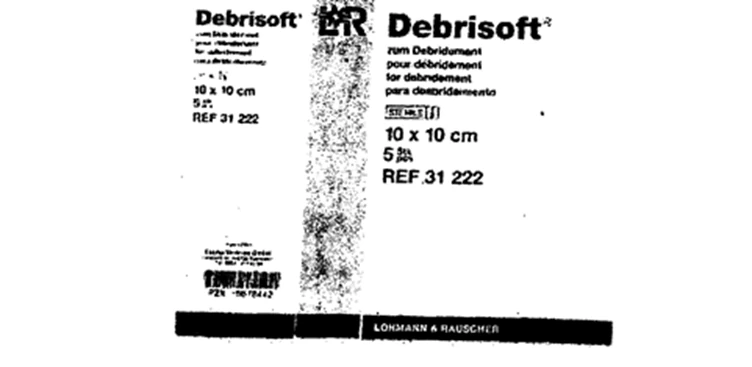
- The defendant (the parallel importer) was an Austrian company that imported the plaintiff’s DEBRISOFT product from Austria to sell it in Germany. Before selling the products in pharmacies, the defendant added a label to the box (which included information about the importing company, its contact details, a barcode, and a pharmaceutical number) and affixed it to the unprinted part of the packaging without covering the plaintiff’s trademark. Below is an image of the packaging in question (the label added by the defendant appears in the lower left corner):
- The defendant had not informed the plaintiff of the reimportation nor had it provided the plaintiff with a sample of the product modified with the new label. This would constitute a breach of requirement 5 set forth above; consequently, in accordance with the CJEU case law outlined above, the trademark owner could, in principle, oppose the subsequent marketing of the product by the parallel importer.
- The German manufacturer considered, in fact, that the defendant’s conduct constituted an infringement of its trademark rights and filed the corresponding infringement lawsuit against the Austrian importer to prevent that company from marketing its DEBRISOFT product.
In response to the question referred by the German Federal Court of Justice as to whether the aforementioned CJEU doctrine on the repackaging of medicinal products would apply to the present case, the CJEU has ruled that the facts of this case differ from those that gave rise to the judgments establishing the principles in question. Thus, the CJEU notes that in those judgments, the parallel importer’s intervention involved not only the affixing of an additional external label but also, in all cases, the opening of the original packaging (specifically, to insert a package insert in a language other than that of the trademark owner). In this case, however, the original packaging would not have been opened, and only a small label would have been affixed to an unprinted area without covering the trademark owner’s mark. Under these circumstances, in the CJEU’s view, the affixing of such a label would not jeopardize the specific purpose of the trademark (guarantee of origin) and could therefore not be considered “repackaging” within the meaning of the cited case law. Consequently, the CJEU concludes that, in the case at hand, trademark exhaustion would occur, thereby preventing the trademark owner from opposing the subsequent marketing by the parallel importer.
This interpretation by the CJEU will mean that the German Supreme Court will have to overturn the lower court rulings, as those rulings had upheld the claim brought by the owner of the DEBRISOFT trademark against the Austrian importer.
In any case, aside from the German litigation, the judgment in question raises an interesting issue. The CJEU does not take into account that the product in question is a medical device and not a medication; rather, it merely examines the specific conduct of the parallel importer in the case at hand. This raises the question of whether this ruling might signal a relaxation of the CJEU’s doctrine regarding the limitation of trademark exhaustion in the context of parallel imports of medications. Indeed, it could be understood that the parallel importation into the EU of a drug to which the importer has added a label under conditions equivalent to those in the case examined here will not be considered “repackaging” within the meaning of the CJEU’s doctrine, and that the importer may freely market said product without having to comply with prerequisites such as prior notification to the trademark owner or providing that owner with a sample of the modified product.
Author: María Cadarso