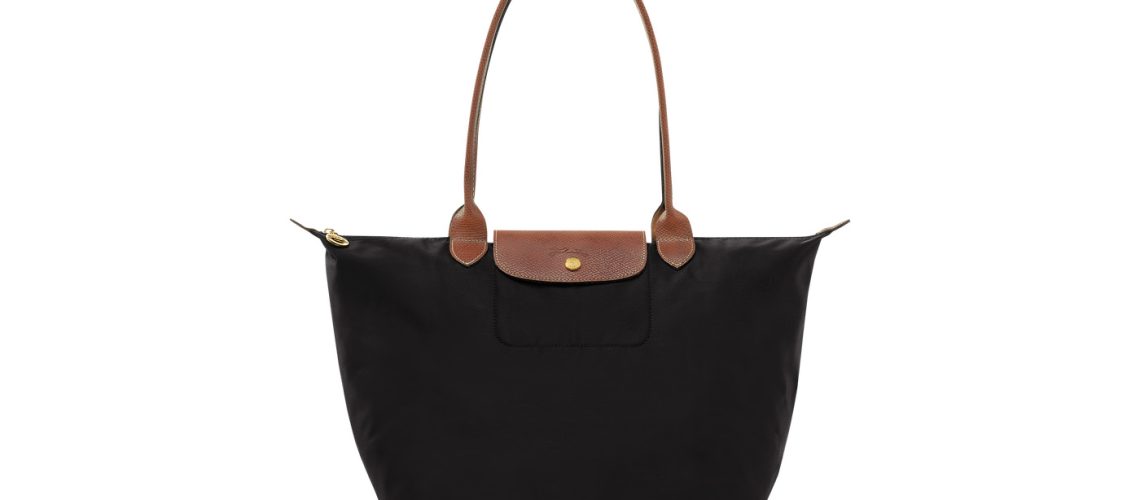

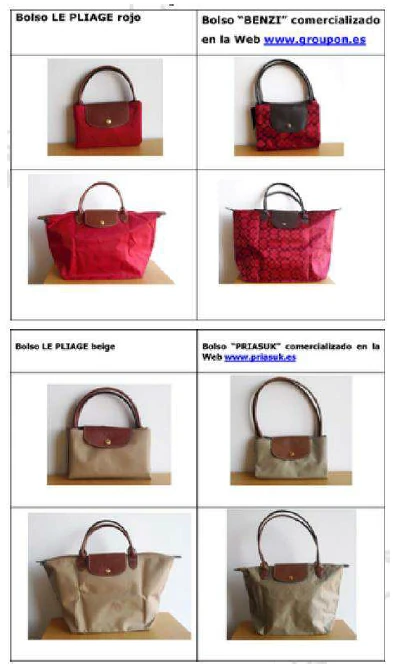
The dispute arose as a result of the sale on the GROUPON website of coupons redeemable for handbags from the company SARASWATI (which operates under the trade name PRISAUK), whose design resembled the 1623 LE PLIAGE model by LONGCHAMP (LE PLIAGE), and whose offer was accompanied by advertising messages such as “Add a French touch to your outfit with a Longchamp-style foldable bag” or “Longchamp-style foldable bag, affordable luxury with a French touch.”
Below is a side-by-side comparison of Longchamp's LE PLIAGE bag and the bags sold by SARASWATI on GROUPON and on its PRIASUK website:
In response to this marketing, CASSEGRAIN—as the owner of the intellectual and industrial property rights to the LONGCHAMP handbags and trademarks—and LONGCHAMP—as the exclusive manufacturer and distributor of the handbags—filed a lawsuit against SARASWATI and GROUPON for trademark infringement, copyright infringement, and unfair competition.
Specifically, the plaintiffs argued that the LE PLIAGE handbag deserved protection as a work of applied art and that the model marketed by SARASWATI was a reproduction of that handbag.
Furthermore, they considered that the use on the GROUPON website of the LONGCHAMP trademark and expressions such as “affordable luxury with a French touch” referred to the origin and market positioning of the LONGCHAMP trademark and constituted an infringement of that trademark, which also enjoys a high level of recognition in its sector.
Finally, the plaintiffs argued that the use of advertising phrases such as “LONGCHAMP style” constituted an act of imitation, exploitation of another’s reputation, unlawful advertising, and deceptive practices based on confusion or association, as provided for in the Unfair Competition Law.
For their part, the defendants denied that the LONGCHAMP trademark was well-known and that the LEPLIAGE bag could be considered a work of authorship. Furthermore, GROUPON sought to invoke the liability exemption provided for in the Electronic Commerce Act, arguing that it had merely reproduced the description provided by SARASWATI and was unaware of the unlawfulness of the information stored on its website.
1. Findings of the Trial Court’s Judgment.
On November 18, 2015, Madrid Commercial Court No. 9 issued a judgment dismissing the claims regarding exclusive rights, intellectual property rights over the handbag, and the trademark for the name “LONGCHAMP,” but upholding the claims regarding unfair imitation and free riding on another’s reputation.
Specifically, the trial judge found that it had not been proven that Longchamp’s LE PLIAGE handbag possessed sufficient originality and creativity to be considered a work protected under the Intellectual Property Law
and that, since the LONGCHAMP trademark had not been used on the product but only in advertising, there was no trademark infringement either, but rather acts of unfair imitation and unfair exploitation of another’s reputation under provisions 11
and 12 of the Unfair Competition Act. Likewise, it concluded that GROUPON could not benefit from the liability exemption under the Electronic Commerce Act, since it had been proven that the design of the advertisement for the disputed handbags had been created jointly by SARASWATI and GROUPON.
2. Overview of the key points of the Madrid Provincial Court’s ruling and a summary of the commentary
The ruling by the Commercial Court, which was appealed by both the plaintiffs and GROUPON, led to the ruling by the Provincial Court of Madrid on September 15, 2017, which almost completely overturned the Commercial Court’s decision, finding that the sale of the handbags on GROUPON’s website infringed the copyright in the LE PLIAGE design and the well-known LONGCHAMP trademark.
The full commentary, available in Issue 22 of the Journal of Competition and Distribution Law, offers a detailed analysis of the key findings of this ruling, which addresses issues of great interest to the fashion industry —so-called “Fashion Law”—such as the protection of creations in this field through copyright—in this case, Longchamp’s “Le Pliage” handbag—; the potential infringement of a well-known trademark when it is used in advertising accompanied by terms such as “style,” “type,” or “imitation”; the principle of relative complementarity between the rules governing exclusive rights and the Unfair Competition Act; and the liability of an information society service provider in relation to these potential infringements.
Author: Cristina Velasco