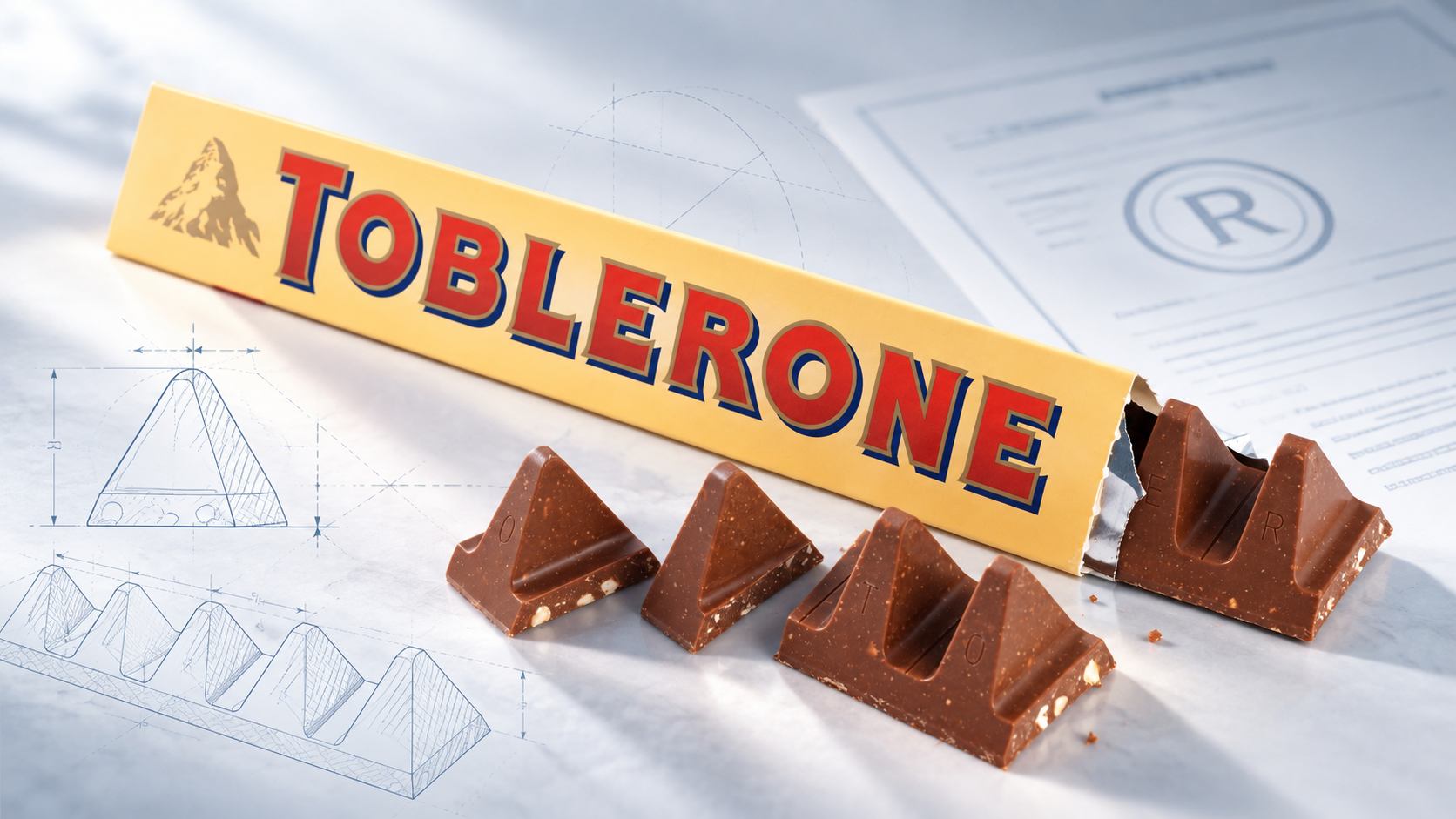

Toblerone's triangular shape is probably one of the most recognizable silhouettes in the chocolate industry. But can a product's shape be protected as a trademark and, therefore, potentially remain protected indefinitely?
The EUIPO has just ruled on this matter. In a decision dated July 8, 2026, its Cancellation Division rejected the application for invalidation filed against the European Union trademark that protects the distinctive shape of Toblerone.
The ruling is particularly interesting for understanding the limits of three-dimensional trademarks: a shape may be registered as a trademark, but not when it is dictated by the nature of the product, is necessary to achieve a technical result, or, in and of itself, adds substantial value to the product.
The Origin of the Dispute: The Toblerone Shape as a Trademark
The proceeding concerns European Union trademark No. 000 031 237, filed in 1996 with a Swiss priority date of 1995 and registered in 1998 for goods such as chocolate, chocolate products, cocoa, and confectionery.
The protected mark does not contain the word "Toblerone." What was registered as a trademark is the three-dimensional shape of the bar itself.
In August 2024, the Polish company Millano filed a request with the EUIPO to have this registration declared invalid. Its main argument was that a design of this nature should not be able to be reserved indefinitely for a single company through trademark law.
The application was based on four main grounds: that the shape lacked distinctiveness; that it arose from the very nature of the product; that it was necessary to achieve a technical result—primarily, the ability to divide the chocolate into portions; and that it added substantial value to the product.
The EUIPO has rejected all of them.
An old patent at the center of the debate
One of the most striking aspects of the proceedings was the use of an old patent as an argument against the trademark.
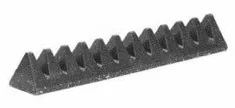
The petitioner seeking a declaration of invalidity submitted documentation regarding Austrian Patent No. 46,199, granted in 1910, for a machine designed to mold and cut chocolate into wedge-shaped pieces (so-called Gianduia chocolate). Her argument was that the bar’s configuration was linked to a technical solution that had already been protected by a patent.
This is no minor issue. One of the reasons European legislation limits the registration of certain forms as trademarks is precisely to prevent trademark law—which allows for indefinite renewals—from being used to extend exclusive rights over technical solutions that should become available to competitors once the patents or designs protecting them have expired.
However, in the EUIPO’s view, the existence of that patent was not sufficient to prove that the specific shape registered as a trademark was exclusively functional.
And here lies one of the key factors behind the decision.
It's not just “a triangle” that's being protected
Before analyzing the various grounds for invalidity, the EUIPO determines exactly what the trademark protects.
The Office describes the mark as a single-piece chocolate bar with a uniform base and a series of twelve separable triangular elements protruding from that base.
This clarification is important because the proceedings were not intended to determine whether a company can generally monopolize the concept of “triangular chocolate.” Rather, that specific configuration had to be evaluated as a whole.
The applicant had cited, among other examples, the Italian Gianduiotto, which is also characterized by a triangular shape. However, the EUIPO considers that chocolate, as a product, does not have a specific natural shape and can be marketed in a wide variety of forms. Nor was it demonstrated that the specific combination of characteristics of Toblerone was a generic shape or one dictated by the nature of the product.
Does the shape of Toblerone serve a technical purpose?
The ability to easily break a tablet into portions clearly has practical utility. But that does not mean that any form that allows this is automatically excluded from trademark protection.
To apply this prohibition, it must be demonstrated that all the essential features of the shape are necessary to achieve the technical result. It is not sufficient for any of its elements to have a practical function.
In the case of Toblerone, the EUIPO considers that the shape goes beyond what is necessary to allow the chocolate to be broken into pieces. The triangular or pyramid-shaped elements are not technically essential to achieve that result, since a bar can be divided into portions using many other shapes.
For this reason, it also rejects this ground for nullity.
What if it's precisely the shape that makes the product appealing?
Another question raised was whether the shape added substantial value to the chocolate.
This is a particularly interesting question when it comes to Toblerone. Its three-dimensional shape is one of its most recognizable features and has played a prominent role in its advertising for decades.
But recognition, appeal, and intrinsic value are not equivalent concepts.
The EUIPO notes that, in applying this prohibition, it may be considered whether the shape is one of the main reasons why consumers purchase the product. However, it considers that products such as chocolate are purchased primarily for other reasons, particularly their taste.
The fact that a shape is distinctive, well-known, or actively used as an element of corporate identity does not, in and of itself, mean that it is that shape that gives the product its substantial value.
A Matter of Time: What the Market Was Like in 1995
The final major argument concerned the distinctiveness of the trademark. Millano argued that dividing a bar into portions was already common practice before Toblerone registered its shape, and he cited products such as KitKat, Kinder Chocolate, and Kinder Bueno as examples.
But the proceeding presented an additional challenge: it was necessary to determine whether the trademark could be considered distinctive in 1995–1996, not whether today’s market features numerous different forms of chocolate.
Furthermore, a registered trademark is presumed to be valid. It was therefore up to the party seeking its invalidation to prove that EUIPO had erred in granting it.
In the Office’s view, the examples provided did not demonstrate that, as of that date, there were designs on the market that were sufficiently similar to the registered trademark. In fact, none of them reproduced its characteristic sequence of triangular elements.
The EUIPO therefore concludes that it has not been proven that the shape lacked distinctiveness at the time of filing.
What does the Toblerone case teach us about three-dimensional trademarks?
The decision ultimately rejects the request for invalidation in its entirety and thus upholds the validity of the trademark. However, it should be noted that the decision may still be appealed before the EUIPO Boards of Appeal and, if necessary, before the General Court of the European Union.
Beyond the well-known shape of Toblerone, this story offers several interesting lessons.
The first is that a product shape can indeed function as a trademark, provided that it is capable of identifying a business origin and does not fall under the absolute prohibitions set forth in Article 7.1.e) of the EU Trademark Regulation regarding product shapes.
And the second point is that the existence of a particular function does not necessarily preclude its protection. The question is whether the shape is entirely dictated by that technical function or whether it incorporates additional features that go beyond what is strictly necessary to achieve the technical result.
The Toblerone case shows that a single shape can initially have a technical or aesthetic dimension and, over time, come to serve as a powerful identifier of a company’s origin.
Therefore, whether designing a protection strategy or challenging a third party’s rights, it is not enough to ask whether a design is well-known, functional, or attractive. It is necessary to analyze which characteristics are being protected, what function they serve, and what evidence can demonstrate how they were perceived at the relevant time.
Laura Rodríguez, Attorney in the Litigation Department at ELZABURU.