Judgment C-237/19 on Three-Dimensional Shape Trademarks
The Court of Justice “clarifies” what role the relevant public or the average consumer should play in analyzing the prohibition on the registration of (three-dimensional) shape trademarks whose subject matter may fulfill a technical function or confer substantial value on the product.
Judgment of the Court of Justice of April 23, 2020, in Case C‑237/19, the Gömböc Case
On February 15, 2015, the Hungarian company Gömböc Kft. filed a trademark application consisting of a three-dimensional sign to distinguish decorative articles (Class 14), decorative articles made of glass and earthenware (Class 21), and toys (Class 28).

The Hungarian Office refused to register the trademark on the grounds that the sign for which registration was sought represented a three-dimensional object which, due to its external design and the homogeneous material used, always returns to its equilibrium position; and that the shape of that object served, in its entirety, to achieve the technical objective of ensuring that it always straightens out (Art. 2.2(b) of the Hungarian Trademark Act = Art. 3.1(e)(ii) and (iii) of Directive 2008/95 on Trademarks).
More specifically, the Office found that, with regard to toys, the object—which always returns to its equilibrium position—was composed of elements designed to achieve that purpose; therefore, those elements fulfill a technical function, and the object is also designed to achieve a specific technical result. With regard to decorative items, the Office held that the object embodied an attractive and decorative design with a casual appearance that influenced the consumer’s purchasing decision and, therefore, added substantial value to the product, which, moreover, had become the “tangible symbol of a mathematical discovery that has provided answers to questions concerning the history of science.”
In assessing the grounds for refusing this trademark, the Office took into account not only the graphic representation of the sign as it appeared in the trademark application file, but also evaluated the relevant public’s perception of that object. In the Office’s view, the public knew from advertising and use of the product that it always returned to its equilibrium position (that is, it fulfilled a technical function). Furthermore, the public also knew that the product embodied the symbolic value of the mathematical discovery described above (and therefore attributed substantial value to the product).
The additional consideration taken into account by the Office in support of its grounds for refusal—particularly with regard to the decorative elements—stemmed from the fact that the subject matter of the trademark was already protected as an industrial design. This circumstance, in the Office’s view, confirmed that such an object—which met the requirement of distinctiveness required for designs—served a decorative function and had an aesthetic appearance that added substantial value to the product.
The refusal to register the trademark was appealed through the various courts all the way to the Hungarian Supreme Court. In light of the doubts raised in resolving the matter, the Supreme Court referred a series of preliminary ruling questions to the Court of Justice (CJ), which are detailed below.
If you would like more details about the ruling, please view the full document.
Author: Jesús Gómez Montero
Former Partner at ELZABURU and Member of the Advisory Committee of the Alberto Elzaburu Foundation
BREXIT: WHAT HAPPENS NOW?
PEACE OF MIND is the guiding principle for any holder of industrial and intellectual property rights starting at midnight tonight—that is, when Brexit, the United Kingdom’s exit from the European Union, takes effect at 12:00 a.m. CET.

Despite the storm clouds that at one point in 2019 foreshadowed an abrupt exit of the United Kingdom from the EU, an agreement has finally been reached that, in addition to setting the terms for that exit, provides for a transition period that, in principle, will last until December 31, 2020, EU law will continue to apply in the United Kingdom. This transition period therefore applies to the Regulations governing the European Union trademark and Community designs, the Regulation governing border measures to combat commercial piracy, and the procedural Regulations applicable to the pursuit of legal actions, among others. It should also be noted that European patents will not be affected by Brexit, since the European Patent Convention, which governs the granting of such patents, is not part of the EU legal system.
The effects of Brexit on industrial and intellectual property rights and other related matters are therefore postponed until January 1, 2021.
ELZABURU se propone enviar durante los próximos meses circulares informativas sobre las consecuencias del Brexit en relación con solicitudes y registros de marcas de la Unión Europea y registros internacionales de marca que designen la UE; también sobre los efectos del Brexit en materia de dibujos y modelos comunitarios; en relación con variedades vegetales y nombres de dominio <.eu>; sobre las solicitudes de intervención aduanera; sobre los procedimientos judiciales en curso o por iniciar; sobre la falta de incidencia hoy por hoy en cuestiones relativas a la patente europea; sobre procedimientos de oposición, nulidad y caducidad de derechos, así como cuestiones relacionadas con la representación para actuar ante la EUIPO.
For now, the message is clear. From February 1 through the end of the transition period, scheduled for December 31, 2020, everything will remain the same in practice: procedures regarding trademarks, designs, and other intangible assets will continue to operate as they have to date.
If you have any questions, please contact brexit@elzaburu.es.
Visit our website:http://www.elzaburu.com/
New Member of the Madrid System in Southeast Asia: Malaysia
Malaysia was the last country in Southeast Asia to deposit its instrument of accession to the Madrid Protocol. On September 27, 2019, this historic milestone took place, placing Malaysia among the 122 members of the Madrid System for the international registration of trademarks.

Among the major countries in Southeast Asia, Malaysia and Myanmar (formerly Burma) were the only ones that had not yet joined this practical and effective system for managing trademarks worldwide. The following countries are part of the system: Singapore, Vietnam, Laos, the Philippines, Cambodia, Brunei Darussalam, Thailand, and Indonesia. Myanmar is now the only country in the region that does not allow for the international registration of trademarks through the Madrid System; however, it is expected to do so in 2020, once its new Trademark Law has been implemented and its administrative system is fully operational. East Timor and other small dependent territories will remain outside the Madrid System, as their accession is undoubtedly very unlikely in the short to medium term.
Like other countries in the Madrid System—particularly neighboring Singapore— Malaysia has reserved certain rights that allow it to adapt international regulations to local ones. Among these, when designating Malaysia through the international system, it is important to note that this country requires a declaration of intent to use the trademark and that such a declaration is deemed to have been implicitly made during the application process. Like some Protocol countries, the deadline for notifying provisional refusals will be extended to 18 months or may be exceeded in the event of an opposition, which may result in a lengthening of the proceedings, as well as various other considerations that Protocol member countries may adopt.
Malaysia’s accession to the Madrid Protocol took effect on December 27, 2019. To achieve this goal, the Malaysian authorities had to go through a lengthy preparation process to finally enact their new Trademark Law, which specifically provides for the country’s accession to the Madrid System and which took effect on the same date.
The new Malaysian law opens registration to non-traditional signs that can be graphically represented (color marks, sound marks, holograms, etc.), collective marks, and multi-class marks, as well as new official deadlines that are more in line with those of other jurisdictions. These are some of the key issues addressed by the new law, which reflect a significant effort to modernize and adapt to the changing times.
Authors:Cristina Arroyo and Juan Miguel Sáinz de Marles
Tell me your favorite color, and I'll tell you what you're like… or who you vote for
In a well-known passage from our most universal work, *Don Quixote of La Mancha*, his friend Sancho said to himself: “I have seen a thousand signs that my master is a madman through and through, and I, too, am not far behind him, for I am more of a fool than he is, since I follow and serve him—if the saying is true that goes, ‘Tell me who you walk with, and I’ll tell you who you are,’ and the other one: ‘It’s not who you’re born with, but who you hang out with.’”
All you need to know is who someone hangs out with or sleeps with to figure out their personality, their way of thinking, and—why not?—even their political leanings.
It’s election season once again. Politicians have taken the stage, along with wordplay, demagogic promises, and… an increasingly polished presentation in which color also seems to play a significant role. The blue of the PP, the red of the PSOE, the orange of CUIDADANOS, and the purple of PODEMOS are now joined by the green of VOX.
Traditionally, blue—a cool, conservative color associated on the political spectrum with the right and conservatives—has been linked, according to experts at
on the psychology of colors, with professionalism, stability, credibility, trust, and even loyalty, security, and steadfastness. Red—a warm, emotional color generally used in politics by left-wing and liberal forces—has always been considered representative of vitality, aggressiveness, passion and enthusiasm, energy, and action. Orange—a warm, sociable, and friendly color that in politics has been linked to various political ideals, though most commonly to Christian Democratic parties—is associated with joy and youth, temperance and sobriety, while also representing optimism, enthusiasm, creativity, modernity, and inspiration. Purple—a cool, deep color linked in the political sphere to feminist movements—has been associated with mystery, magic, melancholy, and dignity; with extravagance and criticism; as well as with wisdom and power (it was, after all, the color of the clergy and the nobility). Over the past decade, these four colors have enlivened our political scene, and we all associate them with one political party or another. But in recent months, the color green—the color of nature and, therefore, of environmental movements—has emerged with great force, and never has this been more apt. The psychological properties of green—a cool color—may seem somewhat paradoxical given what it represents in our current political landscape; it is a refreshing, soothing, and calming color (in fact, it is the color of hospitals and surgeons’ scrubs), primarily associated with stability, balance, tolerance, and sensitivity, symbolizing security and hope.
The psychological aspects of color are very much a part of our daily lives, even if we aren't aware of it. They play an important role in the worlds of marketing, advertising, and design.
In the professional field in which I work—that of trademark protection and defense—color has recently taken on a very important, even pivotal, role. Companies seek to differentiate themselves not only through the products they sell or the services they provide, but also through their association with a particular color, which they attempt to protect—not always with equal success—as a trademark. In the telecommunications industry, blue is the color of TELEFÓNICA, orange is ORANGE’s, red is VODAFONE’s, and purple is ONO’s and YOIGO’s; in the banking sector, we all associate blue with BBVA and SABADELL, red with SANTANDER, green with BANKIA, and orange with BANKINTER or ING; in the insurance sector, red stands for MAPFRE or LÍNEADIRECTA, blue likely for PELAYO or MUTUA MADRILEÑA, and orange for VERTI; in the chocolate industry, red stands for NESTLÉ and purple for MILKA.
However, this psychological association between colors and trademarks is not always complete, since it is usually linked to the name or other graphic elements, without which consumers would not be able to recognize or deduce the origin of the products or services.
A single color is not distinctive for any goods or services, except in exceptional circumstances; those cases in which the applicant can demonstrate that the mark consisting of a color is unusual, that it is striking in relation to the specific goods or services, or that it has acquired distinctiveness as a result of the use made of it—that is, that it is capable of distinguishing certain goods and services from those of other companies. These are very specific cases, such as the European Union trademark consisting of the color lilac or purple for chocolate registered by Kraft Foods; Deutsche Telekom’s registration of the color magenta for telecommunications services; 3M’s registration of the color yellow for sticky notes; Hilti’s registration of the color red for hammer drills; and Chep’s registration of the color blue for pallets.
Most often, however, these attempts at registration are unsuccessful. The aim is to prevent the creation of unjustified monopolies on color shades, which could ultimately give the owner an unwarranted competitive advantage to the detriment of new businesses. Some examples of trademark rejections within the European Union include Banco Santander’s red and BBVA’s blue in the banking sector, and Orange’s orange and Telefónica’s blue in the telecommunications sector.
In the political arena, the psychological perception of colors and their association with one political party or another does not align with their distinctiveness and registrability. Political parties do not seem particularly inclined to register their colors as trademarks, likely because—aside from the difficulties they might encounter—each political party has its own color, whether or not it is registered.
In politics, color is used as a means of distinguishing one party from another, not to create an association with the psychological characteristics of their symbols or their ideological positions. They have succeeded in making us associate blue, red, orange, purple, and green with a political symbol rather than with a way of being.
Tell me what color you prefer, and I'll tell you what you're like… or who you vote for.
Author: Luis Baz
Low-Cost Luxury? Court Ruling Penalizes Counterfeit Longchamp Handbags
The dispute arose as a result of the sale on the GROUPON website of coupons redeemable for handbags from the company SARASWATI (which operates under the trade name PRISAUK), whose design resembled the 1623 LE PLIAGE model by LONGCHAMP (LE PLIAGE), and whose offer was accompanied by advertising messages such as “Add a French touch to your outfit with a Longchamp-style foldable bag” or “Longchamp-style foldable bag, affordable luxury with a French touch.”
Below is a side-by-side comparison of Longchamp's LE PLIAGE bag and the bags sold by SARASWATI on GROUPON and on its PRIASUK website:
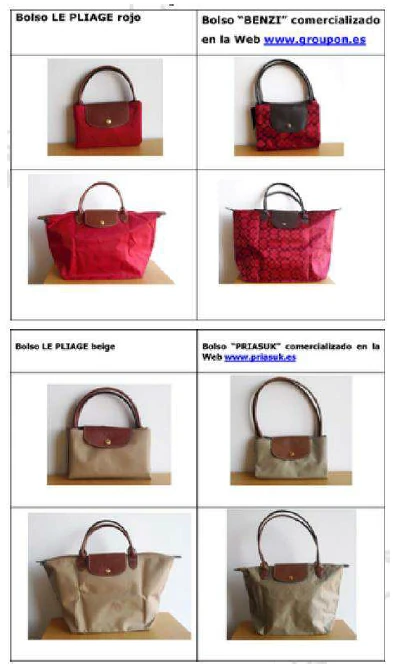
In response to this marketing, CASSEGRAIN—as the owner of the intellectual and industrial property rights to the LONGCHAMP handbags and trademarks—and LONGCHAMP—as the exclusive manufacturer and distributor of the handbags—filed a lawsuit against SARASWATI and GROUPON for trademark infringement, copyright infringement, and unfair competition.
Specifically, the plaintiffs argued that the LE PLIAGE handbag deserved protection as a work of applied art and that the model marketed by SARASWATI was a reproduction of that handbag.
Furthermore, they considered that the use on the GROUPON website of the LONGCHAMP trademark and expressions such as “affordable luxury with a French touch” referred to the origin and market positioning of the LONGCHAMP trademark and constituted an infringement of that trademark, which also enjoys a high level of recognition in its sector.
Finally, the plaintiffs argued that the use of advertising phrases such as “LONGCHAMP style” constituted an act of imitation, exploitation of another’s reputation, unlawful advertising, and deceptive practices based on confusion or association, as provided for in the Unfair Competition Law.
For their part, the defendants denied that the LONGCHAMP trademark was well-known and that the LEPLIAGE bag could be considered a work of authorship. Furthermore, GROUPON sought to invoke the liability exemption provided for in the Electronic Commerce Act, arguing that it had merely reproduced the description provided by SARASWATI and was unaware of the unlawfulness of the information stored on its website.
1. Findings of the Trial Court’s Judgment.
On November 18, 2015, Madrid Commercial Court No. 9 issued a judgment dismissing the claims regarding exclusive rights, intellectual property rights over the handbag, and the trademark for the name “LONGCHAMP,” but upholding the claims regarding unfair imitation and free riding on another’s reputation.
Specifically, the trial judge found that it had not been proven that Longchamp’s LE PLIAGE handbag possessed sufficient originality and creativity to be considered a work protected under the Intellectual Property Law
and that, since the LONGCHAMP trademark had not been used on the product but only in advertising, there was no trademark infringement either, but rather acts of unfair imitation and unfair exploitation of another’s reputation under provisions 11
and 12 of the Unfair Competition Act. Likewise, it concluded that GROUPON could not benefit from the liability exemption under the Electronic Commerce Act, since it had been proven that the design of the advertisement for the disputed handbags had been created jointly by SARASWATI and GROUPON.
2. Overview of the key points of the Madrid Provincial Court’s ruling and a summary of the commentary
The ruling by the Commercial Court, which was appealed by both the plaintiffs and GROUPON, led to the ruling by the Provincial Court of Madrid on September 15, 2017, which almost completely overturned the Commercial Court’s decision, finding that the sale of the handbags on GROUPON’s website infringed the copyright in the LE PLIAGE design and the well-known LONGCHAMP trademark.
The full commentary, available in Issue 22 of the Journal of Competition and Distribution Law, offers a detailed analysis of the key findings of this ruling, which addresses issues of great interest to the fashion industry —so-called “Fashion Law”—such as the protection of creations in this field through copyright—in this case, Longchamp’s “Le Pliage” handbag—; the potential infringement of a well-known trademark when it is used in advertising accompanied by terms such as “style,” “type,” or “imitation”; the principle of relative complementarity between the rules governing exclusive rights and the Unfair Competition Act; and the liability of an information society service provider in relation to these potential infringements.
Author: Cristina Velasco
Philippines: New Declaration of Current Use to Maintain Trademark Rights
A significant legislative development has taken place in the Philippines regarding the maintenance of trademark rights. The change consists of a requirement for a new Declaration of Current Use (hereinafter “DAU”) in this jurisdiction. The
Intellectual Property Office of the Philippines (IPO) has established this requirement in Circular No. 17-010 (Trademark Regulations of 2017), effective as of August 1, 2017.
Apparently, the change stems from the need to bring Philippine trademark legislation into line with the provisions of the Madrid Protocol, although there may also be other reasons aimed at restricting the exclusive registration of umbrella trademarks or even the imposition of a new fee. It is not our purpose here to analyze the reasons behind this development, but rather to explain as simply as possible what these changes entail.
Until now, to maintain trademark rights in the Philippines, it was necessary to prove use by filing a Declaration of Use (DAU) and providing evidence of such use. Under the new Trademark Law, proof of use will be required at different stages of the trademark’s life cycle:
- On the third anniversary of the date the trademark application was filed,
- Between the fifth and sixth anniversaries of the trademark's registration date and
- Between the fifth and sixth anniversaries of the brand's relaunch.
Circular No. 17-010 introduces an additional DAU, in addition to those already required by current legislation, which must be filed within one year of the trademark’s expiration date.
The requirement to file the DAU would apply to both Philippine national trademarks and international registrations designating the Philippines, as well as subsequent designations of international registrations in this country. When a trademark has been protected through the international registration system, although the deadline is also one year, it will be calculated from the date of renewal of the international trademark.
Circular No. 17-010 is truly convoluted, as it appears to indicate that the requirement for the new DAU will apply retroactively to trademarks that were renewed on or after January 1, 2017, and at the same time seems to suggest that all trademarks must comply with this requirement within one year of their expiration date.
In practice, for any trademark to be maintained in the Philippines, a DAU must be filed within the established one-year period following its expiration date, and this requirement must be repeated at the end of each 10-year registration term.
In the near future, trademark owners whose trademarks were set to expire on or after January 1, 2017, must comply with the requirement to file a DAU before the end of the one-year period following the expiration date. Trademark owners who renewed their trademarks during 2017 and wish to maintain them should be aware that they must comply with this requirement.
With regard to international trademarks, such retroactivity would not actually apply because the Philippines acceded to the Protocol on July 25, 2012. It will not be until 2022 that the first international trademarks designating this jurisdiction will need to be renewed. In this regard, Article 14(5) of the Madrid Protocol establishes that, with respect to international registrations made under the Protocol prior to the date of accession of the Contracting Party in question, subsequent designation is not permitted; consequently, there would be no subsequent designations of international trademarks in the Philippines that would be retroactively affected by this change. In the case of international trademarks, this is a development to keep in mind for the more distant future.
Author: Cristina Arroyo